
What Do We Do With 30, 40, or 50 Years of Mom or Dad's Belongings?

You do not have to make a decision about every single thing in Mom or Dad's house before you can move forward. Start with what they actually need, protect the important and sentimental items, let the family make the personal decisions, and then build a practical plan for what gets sold, donated, moved, stored, or thrown away.
This is one of the biggest things that stops families in their tracks. Mom or Dad needs to move. Maybe it is assisted living, independent living, or moving in with family. Then everybody walks into the house and looks around.
Forty years of furniture, boxes in the basement, closets that have not been emptied in decades, photo albums, tools, china, books, and holiday decorations. Things nobody even remembers buying. Suddenly the family is thinking, "How are we supposed to deal with all of this?"
That is a legitimate question. But I do not think the answer is to stand in the middle of the house and try to make 10,000 decisions at once.
We need a process.

Do we have to go through everything before Mom or Dad moves?
No. In most situations, the family does not need to completely sort, empty, sell, donate, or dispose of everything before Mom or Dad moves. Start by identifying what they actually need in the new place. Once they are settled, the family can work through the rest of the belongings in a much more organized way.
This is where I think families put way too much pressure on themselves. They think the entire house has to be solved before anything else can happen. It does not.
If Mom needs assisted living now, I want to know what she needs to take with her. Clothes, medications, important documents, a favorite chair, family photographs, and maybe a few pieces of furniture. Whatever actually makes the new place feel like home.
The 17 boxes in the basement do not necessarily have to be handled before that move happens. The family can come back to those.
Broomfield is not a small senior market either. According to the U.S. Census Bureau, about 17.1% of Broomfield County residents are age 65 or older. These transitions are happening all over our area, and families are dealing with the exact same problem.
You can review the U.S. Census Bureau's Broomfield County data here.
Who decides what stays and what goes?
The family does. My role is not to decide which belongings matter, what should be donated, or what needs to be thrown away. I can help put structure around the process, explain what usually works, and connect the family with professionals who can help, but those personal decisions belong to Mom, Dad, and the family.
I want to be really clear about this because every family is different. I am not walking into somebody's house and deciding what happens to Grandma's china. That is not my job.
I do not know which photograph matters, which piece of furniture has been in the family for three generations, or which box in the basement has something important in it. The family does.
What I can do is help make the process less overwhelming. We can talk about the order and what probably needs to happen first. I can connect you with movers, donation resources, estate sale companies, cleanout companies, junk removal, and other professionals if those services make sense.
But the family is driving the bus. You decide what matters.
What should we pull out of the house first?
Start with the things that are difficult or impossible to replace. That usually means legal and financial documents, medications, jewelry, family photographs, heirlooms, sentimental items, and anything Mom or Dad specifically wants in the new home. Do not start with the garage or the junk drawer just because they are easier decisions.
I like starting with the important stuff because once the process gets moving, things can happen quickly. Movers show up, family members start filling boxes, donation piles grow, and somebody rents a dumpster. That is when I want the valuable and sentimental things already separated.

| Pull Out First | Decide Later |
|---|---|
| Legal and financial documents | Extra furniture and household goods |
| Medications and jewelry | Books and kitchen items |
| Photographs and family heirlooms | Tools and decorations |
| Sentimental items and anything Mom or Dad specifically wants | Garage contents and anything that does not need an immediate answer |
You do not have to start at one end of the house and work your way to the other. Start with the things that would really hurt if they disappeared. Then work outward from there.
How do we keep sentimental items from stopping the whole process?
Sentimental items deserve time, but they do not have to control the entire transition. Create a separate category for things the family is not ready to decide on yet. That keeps important memories protected without forcing everyone to stop and debate every photograph, piece of furniture, or keepsake while the rest of the move is waiting.
This is probably the hardest part because we are not really talking about stuff anymore. We are talking about memories. Dad's tools may remind somebody of working in the garage with him. Mom's dishes may remind the family of every Thanksgiving they had in that house.
A chair may just look like an old chair to me. To the family, that might be the chair Grandpa sat in every night for 30 years.
So I do not think the answer is, "Just get rid of everything." That is not realistic. But I also do not think the entire process should stop because nobody can decide what to do with one box of photographs.
Make a "decide later" category. Protect those things. Keep moving.
Should we sell, donate, move, store, or throw things away?
Usually it is a combination of all five. Some belongings go with Mom or Dad. Some go to family. Some may have enough value to sell. Many things can be donated. Some may need storage temporarily. And some items simply need to be disposed of. The goal is not to force every item into one solution.
This is where having categories helps.
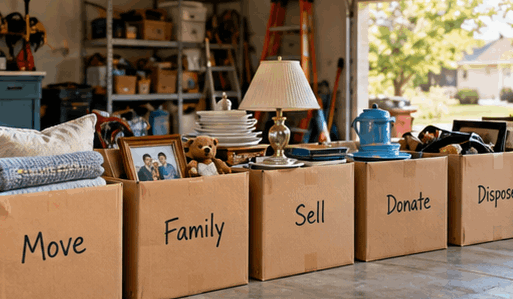
| Category | What belongs here |
|---|---|
| Move | Things Mom or Dad needs in the new home. |
| Family | Heirlooms, photographs, sentimental furniture, keepsakes, and items family members want to preserve. |
| Sell | Furniture, collectibles, tools, jewelry, antiques, or other items with meaningful resale value. |
| Donate | Usable household goods, clothing, books, furniture, and other accepted items. |
| Store | Items the family is not ready to decide on yet but does not want to lose. |
| Dispose | Broken, damaged, expired, unsafe, or unusable items. |
The point is to create lanes. Once everything has a lane, the house starts becoming manageable.
Where can Broomfield families donate household belongings?
Broomfield families have several local donation options, but different organizations accept different items. ARC Thrift, Goodwill, Habitat for Humanity ReStore, and A Precious Child are among the resources identified in Broomfield's recycling and reuse information. Always check current acceptance rules before loading a truck because those requirements can change.
This is where I would rather connect a family with the right resource than tell them to just start dropping things off somewhere.

The City and County of Broomfield maintains a Broomfield Recycling Guide with local reuse, recycling, and disposal options.
Depending on the item, families may be able to use organizations such as:
- ARC Thrift
- Goodwill
- Habitat for Humanity ReStore
- A Precious Child
But not everything belongs in the donation pile. Old paint does not. Expired medication does not. Certain electronics do not, and some chemicals definitely do not.
Broomfield also provides dedicated options for medication disposal and household hazardous or electronic waste.
That matters because a 40-year household usually has at least a few things that need special handling.
When should we bring in professional help?
Bring in professional help when the size of the job, the family's location, the timeline, or the emotional weight makes it difficult to handle everything yourselves. That may mean movers, estate sale professionals, donation pickup, junk removal, cleanout companies, or specialty services. The family still makes the decisions, but professionals can do much of the physical work.
There is no prize for doing all of this yourself. If three adult children live out of state, flying everybody to Colorado for four weekends may not make sense. If the house is extremely full, the physical work may simply be too much. If Mom or Dad needs to move quickly, time may be the biggest issue.
That is when I think professional help can be really valuable.

My role is to help connect the dots. If you need a mover, I can help point you toward movers. If you need an estate sale company, we can talk about that. If you need donation pickup, hauling, or cleanout help, I can help connect you with people who do that work.
You are still making the decisions. You just do not necessarily have to lift every box.
What if the house is extremely cluttered or overwhelming?
Do not be embarrassed by the condition of the house. I have walked through homes with decades of accumulated belongings, deferred maintenance, packed rooms, overgrown yards, and plenty of other challenges. My job is not to judge how the property got there. My job is to understand the situation and help the family figure out the next practical step.
I think this matters because families apologize to me all the time. "I'm sorry the house looks like this." "Mom stopped taking care of things." "Dad never threw anything away." "We know this is bad."
You do not have to apologize to me. People get older. They get tired. Maintenance gets delayed, possessions accumulate, and one box turns into ten. One room gets difficult to use, and then another one does.
That is life. We do not need to spend time judging it. We need to figure out what happens next.
Broomfield's own Spring Cleanup program gives you an idea of how much household material people are dealing with locally. In 2025, the program made 9,125 stops and collected more than 1,014 tons of material. That is not senior-specific, but it does show that large household cleanouts are hardly unusual.
You can review the Broomfield Spring Cleanup information here.
Should we completely empty the house before figuring out what to do with the real estate?
Not necessarily. Before the family spends weeks emptying the property or thousands of dollars on cleanup, I would rather understand the real estate strategy. We can evaluate the house while belongings are still there. Then the family can decide how much needs to be removed, what work makes sense, and which sale strategy produces the best practical result.
This is an important distinction. You do not have to have an empty house before I can walk through it. I can still look at condition, understand the neighborhood, evaluate renovation possibilities, and compare an as-is sale against doing some work.
And that matters because the house may represent a substantial amount of money.
According to August 2026 REcolorado and InfoSparks market data, the median sale price in Broomfield was about $610,000. DMAR's local market reports use REcolorado as their underlying data source.
You can review DMAR's Broomfield market reporting here.
That does not mean Mom or Dad's house is worth $610,000. It could be worth more or less. But it does mean there may be a significant financial asset sitting underneath all of those boxes.
I want to understand the house before the family starts spending a bunch of money on it.
What does this look like in a real senior transition?
I have worked with families where the senior needed to move and the property still had extensive belongings and deferred maintenance. The family worked through the personal possessions, and I helped coordinate the next steps around the move, property, cleanup, preparation, and sale. We did not need every problem solved before we could start moving forward.
One of those properties was in Arvada. The senior needed assisted living, the house had extensive contents, and there was deferred maintenance. The yard had gotten completely away from them. The weeds were about six feet tall. I am not exaggerating.
The family had plenty to deal with. But we did not look at the house and decide everything had to be solved on day one.
The senior got moved, and the family worked through the belongings. I helped coordinate the property side of the transition. The home was cleaned up, the oak floors were refinished, the kitchen was freshened up, and the yard was handled. Then we got the house sold.
That is how I look at these situations. Figure out the next problem. Solve that one. Then keep going.
What is the simplest way to start if we are completely overwhelmed?
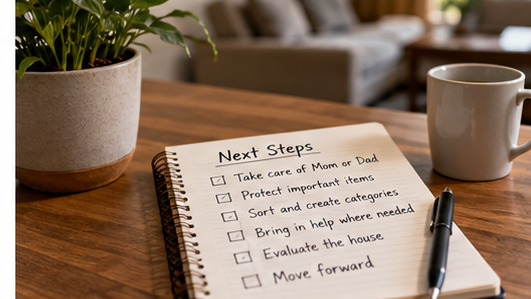
Do not start by trying to empty the whole house. Start with one question: what does Mom or Dad need right now? Then protect the irreplaceable items, create simple categories for everything else, and decide where professional help makes sense. You do not need the entire plan finished before you take the first step.
- Step 1: Take Care of Mom or Dad
Figure out what they need in the new home and get those items separated first.
- Step 2: Protect the Important Stuff
Documents, photographs, valuables, heirlooms, medications, and sentimental items.
- Step 3: Create Categories
Move, family, sell, donate, store, dispose, and decide later.
- Step 4: Bring In Help Where Needed
Movers, estate sale companies, donation pickup, junk removal, cleanout professionals, or other specialists.
- Step 5: Evaluate the House
Understand the property and the real estate options before spending money unnecessarily.
You do not have to personally carry 50 years of belongings to the finish line. But the family does need a process. Once there is a process, the situation starts feeling a whole lot more manageable.
What if we just want somebody to help us figure out where to start?
If you are looking around Mom or Dad's house wondering how your family is ever going to get through all of it, you do not need somebody showing up and pushing you to sell the house. Sometimes you just need help putting the pieces in the right order and figuring out which professionals can help with each part.
If you would like to have a conversation with absolutely no strings attached, give me a call or send me a text. We can talk through what is going on and figure out what needs to happen first.
What should the family handle? Where might professional help make sense? What does the house look like, and what are the different options from here?
You do not have to list the house, hire me, or have everything figured out before you call.
Call or text Scott Jensen at 720-352-7704.
At the end of the day, we are just trying to turn something that feels completely overwhelming into a process.
Take care of Mom or Dad. Protect the things that matter. Let the family make the personal decisions. Bring in help where it makes sense. Then keep moving forward until we reach the finish line.
Recent Posts