
I Have a Family Emergency and Need to Move Closer to Relatives. What Should I Do With My House if I Don't Have Much Time?

If a family emergency means you need to move quickly, you don't necessarily have to sell your house before you leave. Depending on your situation, you may be able to move first, sell the property as-is, prepare it for a traditional sale, or consider renting it. The important thing is understanding your options before making a rushed decision.

I'll tell you, life has a way of throwing things at us when we least expect it. Maybe Mom or Dad is having health problems, and you need to move closer to help take care of them. Maybe something has happened with your kids, your spouse, or another family member, and you suddenly need to relocate. Or maybe you've got a situation that's going to require you to move out of Colorado altogether. Whatever the circumstances, now you've got a house to deal with.
And the last thing you want to be doing during a family emergency is trying to figure out contractors, cleaning crews, real estate showings, repairs, and closing documents. So naturally, the first thought is, "I've got to sell this house as quickly as possible." Well, maybe. But here's where I want you to think about this a little differently. Just because you need to move quickly doesn't necessarily mean you need to sell your house quickly. Those are two different things.
And depending on your financial situation, the condition of your home, and your timeline, we may be able to come up with a plan that lets you take care of your family without making a rushed decision about one of your biggest financial assets.
What Should I Do With My House if a Family Emergency Forces Me to Move?
The first thing I would do is figure out how quickly you need to leave, whether you need money from the house immediately, and whether you plan to return. From there, we can compare selling as-is, preparing the property for market, moving first and selling later, or keeping the house as a rental.
Here's how I look at these situations. Before we even start talking about putting a sign in the yard, I want to understand what's actually happening. Do you need to leave next week? Do you have 30 days? Or are you looking at a couple of months? And here's another important question. Do you need the money from selling the house to make this move happen, or do you have the financial ability to move first and deal with the property afterward? Because that makes a huge difference in how we approach this.
If you've got the resources to relocate and carry the house for a little while, we may have more flexibility. But if you need the equity from the property immediately, we're probably going to evaluate some faster-selling options. Neither approach is automatically right or wrong. What matters is figuring out what works for your situation. And that's something I want to be very clear about. The family is driving the bus. My job is to lay out the different possibilities, run the numbers, and help you make a decision that makes sense.
Can I Move Out of Colorado Before My House Is Sold?
Yes. You can move away before selling your Colorado home, and much of the real estate process can potentially be coordinated while you're living somewhere else. The key is making sure someone local can manage property access, necessary maintenance, contractors, showings, and the other details required to prepare and sell the home.

And honestly, this is something I think a lot of homeowners don't realize. They assume they have to stay in Colorado until the house is completely cleaned out, listed, sold, and closed. But that's not necessarily the case. Let's say you live in Broomfield, and your parents are in another state. Something happens, and you need to move closer to them immediately. You may not have the time or energy to spend the next two months coordinating work on your house. So what if we could handle a lot of that after you've already moved?
Depending on the property and the arrangements we make, I can help coordinate cleaning crews, contractors, painting, flooring, landscaping, photography, and the other pieces involved with preparing the house for sale. I also use shared project calendars to help keep everyone informed about what's being done and when. That way, you're not constantly wondering whether the painter showed up or when the carpets are getting installed. We can schedule the work, coordinate the appropriate people, and keep you updated.
Now, there are still things we need to figure out before you leave. Who's going to have access to the property? Are there personal belongings that need to be removed? What happens with the utilities? Who's checking on the house? Those details matter. But the point is, you may not need to put your family emergency on hold just to deal with the real estate.
How Long Could It Take to Sell My House in Broomfield or the Denver Metro Area?
Home-selling timelines vary, but recent local data shows why planning ahead matters. In September 2026, homes in Broomfield County spent a median of 47 days on the market, while REcolorado reported 33 median days in the MLS for sold Denver Metro homes. Preparation and the closing process can add more time.
Now, that's not to say every home is going to take 33 or 47 days to sell. Some properties move much faster, and others take considerably longer. According to Realtor.com's September 2026 Broomfield County Housing Report, the median sold price was $605,000, and homes sold for approximately 100% of asking price on average. The September 2026 REcolorado Denver Metro report showed a median closed price of $575,000 and 2,898 completed sales.
| September 2026 Market Indicator | Broomfield County | Denver Metro |
|---|---|---|
| Median Market Time | 47 days on market | 33 days in MLS |
| Median Sold Price | $605,000 | $575,000 |
| Sale-to-List Price Ratio | Approximately 100% | Not compared here |
Sources: Realtor.com and REcolorado, September 2026. The two reports use different property populations and methodologies, so these figures should not be treated as identical measurements.
Now, here's something I always want homeowners to understand. Days on market doesn't mean that's exactly when the money shows up in your bank account. We've still got inspections, appraisal or financing issues when applicable, title work, and closing. And if your house needs preparation before listing, there's additional time involved. So if you need to relocate immediately, we need to build a realistic plan for what happens with the house during that period.
Should I Sell My House As-Is, Fix It Up, or Rent It Out?
That depends on how quickly you need money, whether you expect to return, and how much responsibility you want to keep after moving. An as-is sale may reduce preparation time. Improvements may increase your net proceeds. Renting might provide income, but it also creates ongoing costs, management responsibilities, and financial risks.

This is really where I like to spend some time working through the numbers. Because I don't believe in walking into somebody's house and telling them there's only one way to handle it. I want to evaluate several possibilities.
Option 1: Sell the house as-is.
Maybe you don't have time to deal with repairs, painting, flooring, or coordinating a bunch of contractors. We may be able to sell the home as-is to a buyer who's comfortable handling the work. That could be a cash investor or another buyer who understands the property's condition. It's potentially faster and requires less preparation, but the offer may be lower than what we could achieve through another strategy.
Option 2: Give the house a little spit shine.
Sometimes we don't need to do a full renovation. Maybe the house just needs a good cleaning, some paint, updated flooring, and a little landscaping. Those improvements may help attract buyers and potentially improve the sale price. But we need to figure out what they cost and whether they're actually worth doing.
Option 3: Make larger improvements.
Depending on the neighborhood and the condition of the home, there may be an opportunity to do more extensive work. But again, the numbers have to make sense. I'm not interested in spending $60,000 on a house just to increase the sale price by $50,000. That's not helping anybody.
Option 4: Keep the house and rent it.
If you expect to return or want to keep the property as a long-term investment, renting might be worth evaluating. According to Realtor.com's September 2026 data, the median advertised rent in Broomfield County was $2,875 per month. Now, that doesn't mean your particular house would rent for that amount, and it certainly doesn't mean you'd make $2,875 in profit. You still have expenses, possible vacancy periods, repairs, management, insurance, and potentially a mortgage.
And if you're moving away to deal with a family emergency, do you really want the additional responsibility of managing a rental property from another state? Maybe you do. Maybe you don't. That's something we need to discuss.
How Much Will It Cost to Keep My Colorado House After I've Moved Away?
Even after you've moved out, the house can continue costing you money every month. Mortgage payments, property taxes, insurance, utilities, HOA dues, maintenance, and yard care may still apply. If the property sits vacant while you're paying for housing somewhere else, those expenses can add up quickly and affect your final net proceeds.

Here's an area that I think people sometimes overlook. They move away and assume the only expense they have to worry about is the mortgage. But we've got other things happening.
| Expense | What to Check |
|---|---|
| Mortgage | Monthly principal, interest, and any escrow payments |
| Property Taxes | Actual county tax bill and payment schedule |
| Insurance | Coverage and costs for a vacant or unoccupied home |
| Utilities and HOA | Electricity, heating, water, HOA dues, and other fees |
| Property Maintenance | Lawn care, snow removal, security, repairs, and inspections |
For property taxes, the City and County of Broomfield's Property Tax 101 resource explains how assessed property values, assessment rates, and mill levies affect the actual tax bill. For tax year 2025, Colorado used residential assessment rates of 7.05% for school mill levies and 6.25% for non-school mill levies, as Broomfield explains. Those percentages aren't your effective property tax rate, so we need to look at your actual bill.
And here's something especially important. If the house is going to be sitting empty, you need to talk with your insurance company. The National Association of Insurance Commissioners warns that vacant and unoccupied homes may have coverage limitations under standard homeowners insurance policies. So we don't want to assume everything is covered simply because you've been paying the insurance bill. Let's get the right information before leaving the property empty.
I also like to put together a simple holding-cost calculation. We take your actual monthly expenses and compare what it could cost to keep the house for another 30, 60, or 90 days. Then we weigh those costs against the potential benefit of a different selling strategy. Because sometimes spending another month preparing the property makes financial sense. Other times, it doesn't. That's why I like to run the numbers.
Can Someone Handle the Cleaning, Repairs, and Home Sale After I've Already Moved?
Yes, many parts of preparing and selling a home can be coordinated while you're living elsewhere. With the right arrangements, local professionals can handle cleaning, landscaping, painting, flooring, repairs, photography, and showings. I help coordinate those moving parts and keep homeowners updated, so they don't have to return for every appointment.
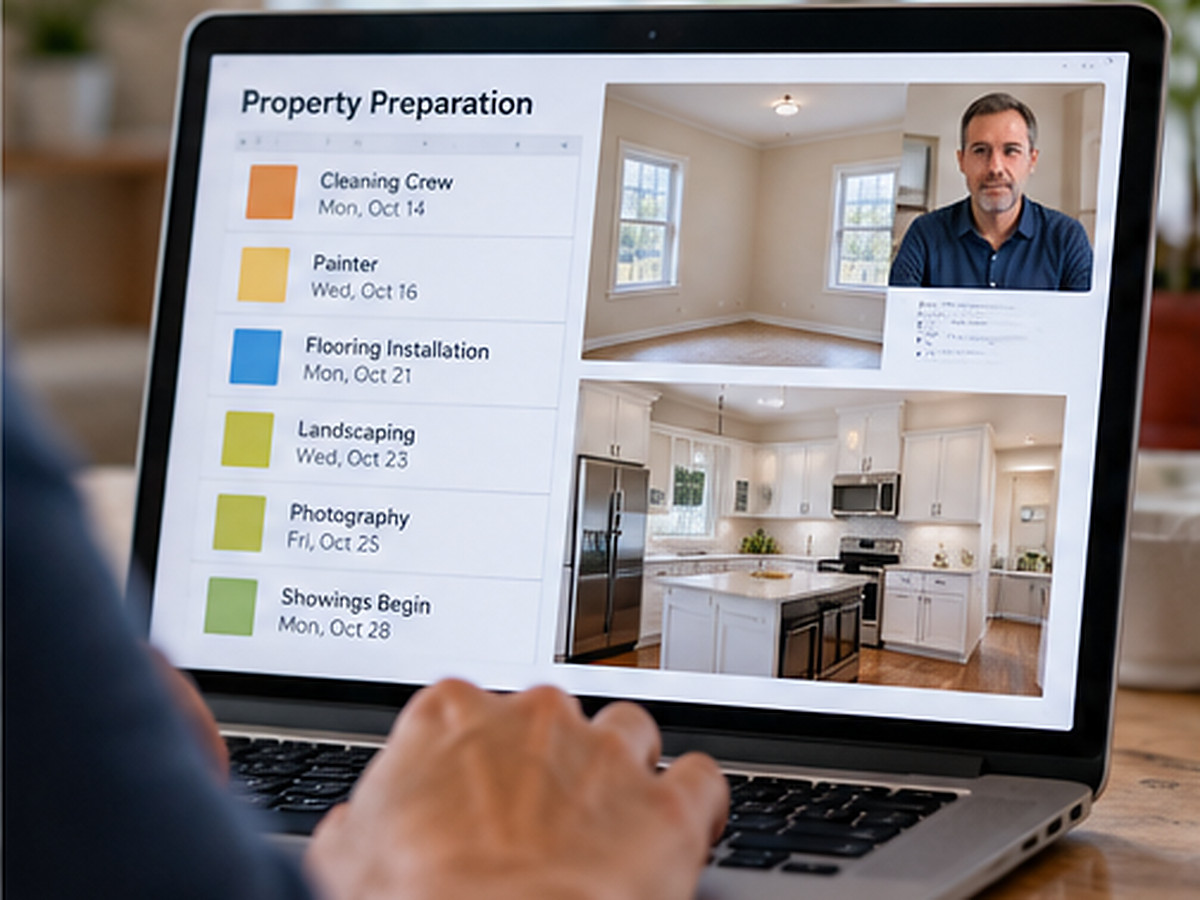
Now, this is one of the areas where I do things a little differently from a traditional real estate agent. I'm not just looking at what we can list the house for. I'm looking at everything that needs to happen to get the property from where it is today to the finish line. Maybe we've got some furniture that needs to be moved out. Maybe we need an estate sale company or professional cleanout crew. Maybe we've got painting, flooring, a handyman punch list, or a yard that needs some attention.
And if you're now living in another state, you're probably not going to want to fly back every time somebody needs to get into the house. So once we've decided on a strategy, I can help organize the work, coordinate the appropriate vendors, and put a schedule together. I use Google Calendar to help clients see what work is scheduled and when. That gives people a much clearer picture of what's happening rather than constantly calling different contractors and wondering if anything is getting done.
Of course, the exact scope of the work depends on the property, the services we've agreed upon, and the family's decisions. But my goal is to take as much of that real estate burden off your plate as we reasonably can. Because if you've got a family emergency happening, that's where your attention needs to be. Not worrying about whether somebody showed up to clean the gutters.
Can I Sign Closing Documents if I'm Living in Another State?
Yes, selling your Colorado home after relocating is often possible without returning for every signature. Depending on the title company, lender, and documents involved, you may be able to sign in advance, use a mobile notary, or complete an approved remote notarization. The arrangements need to be confirmed early because not every transaction supports every signing method.

Here's another question I get from people who are relocating. "What happens when the house sells? Do I have to fly back to Colorado for closing?" Well, not necessarily. There are different ways to handle closing paperwork, depending on the circumstances. Sometimes the title company can arrange for a mobile notary where you're living. Sometimes documents can be signed ahead of the scheduled closing, following the title company's instructions. And in certain situations, approved remote online notarization may be an option.
Under Colorado's remote notarization law, an authorized Colorado remote notary can notarize certain electronic documents for signers who are physically located outside Colorado, subject to the applicable legal requirements. But that doesn't mean we can simply jump onto a video call and sign every closing document. The title company needs to confirm which documents, notarization process, and recording arrangements it will accept. That's something I want to coordinate early rather than discovering a problem a day before closing.
The bigger point is that moving away doesn't necessarily prevent you from selling your Colorado home. We just need to organize the process correctly.
Could Renting My House Instead of Selling Create Tax Problems Later?
It could, depending on how long you rent the property, whether it was your primary residence, and your overall tax situation. Homeowners may qualify for a federal capital gains exclusion when selling a primary residence, but rental use and depreciation can change the tax calculation. This is worth discussing with a qualified tax professional before deciding.
Now, I'm not a CPA, and I'm not going to pretend to be one. But I do think it's important for homeowners to understand that keeping the house and turning it into a rental can have tax consequences down the road. Under IRS Topic No. 701, eligible homeowners may be able to exclude up to $250,000 in capital gain when selling their primary residence, or up to $500,000 for certain qualifying joint filers. Generally, the rules include owning and using the home as a primary residence for at least two of the five years before the sale, along with other eligibility requirements.
Here's where it gets interesting. If you move away and rent the home for several years, your tax situation may change. Rental depreciation and other rules can also affect your taxable gain when you eventually sell. On the other hand, the IRS recognizes certain exceptions and reduced exclusions related to health, employment, and unforeseen circumstances. For example, a move to provide care for a qualifying family member may be relevant under the rules described in IRS Publication 523, Selling Your Home. That doesn't automatically mean your particular move qualifies.
So if you're considering renting the house, I want you to get appropriate tax advice before making a long-term decision. Sometimes keeping the home makes financial sense. Sometimes selling sooner is the better choice. Let's understand the bigger picture.
How Do I Avoid Losing Money Because I Have to Move Quickly?
The best way to avoid an unnecessarily expensive decision is to compare realistic options before committing. Look at the property's current value, the cost of repairs, how quickly you need money, ongoing holding expenses, and potential net proceeds. A rushed decision isn't always avoidable, but understanding the numbers can help protect your financial interests.
Here's what I really don't like seeing. Somebody has a family emergency, they're stressed out, and they assume they have to accept the first offer that comes along. Maybe that offer makes sense. But maybe it doesn't. That's why I like building different scenarios. Let's look at what a qualified investor might pay for the house as-is. Then let's look at what happens if we clean it up, spend some money on improvements, and put it on the traditional market. Maybe we also look at whether renting the house makes sense. Then we compare the estimated sale proceeds, expenses, holding costs, and financial risks.
Because I don't want to just tell you that your house could sell for a certain amount. I want to know what you're actually going to walk away with. And this is where I get a little geeky with the spreadsheets. But the numbers matter. Let's say one scenario produces a higher sale price but also requires more money in repairs, more holding expenses, and another two months of managing the property. Is that really the better option? Maybe. Maybe not. We need to put everything on the table. Then you decide what works best for you.
What Should I Do Before Leaving My Colorado Home During a Family Emergency?
Before leaving, make sure the house is secure, important belongings and documents are handled, insurance coverage is appropriate, and someone can access the property if necessary. Then establish your moving timeline, financial needs, and the options for selling or keeping the home. Those steps can make the process more manageable from a distance.
Here's where I'd start.
- Figure out your timeline. When do you absolutely need to leave? Is there flexibility, or are you dealing with something immediate?
- Understand the money. Do you need cash from the house to relocate? Can you afford to carry the property temporarily?
- Secure the property. Make arrangements for keys, access, utilities, mail, and ongoing maintenance.
- Talk with your insurance company. Make sure your coverage is appropriate if the property will be empty or rented.
- Evaluate the house. Look at the condition, estimated value, belongings, repairs, and available sale strategies.
- Compare the numbers. Review an as-is sale, prepared sale, moving first, or renting where appropriate.
- Put a plan together. Coordinate vendors, timing, listing, showings, and closing arrangements based on the option you choose.
And then we start working through it. Some situations are pretty straightforward. Others have a lot of moving parts. But the important thing is that we have a plan instead of making decisions out of panic.
Who Can Help Me Sell or Manage My Colorado House if I Need to Relocate Quickly?
If a family emergency means you need to move quickly, I can help you evaluate what to do with your house and coordinate the real estate side of the transition. We'll review the property, compare your options, work through the numbers, and determine what needs to happen if you're leaving before the home sells.
I'm Scott Jensen with ReZion Realty, brokered by eXp Realty, in Broomfield, Colorado. I help homeowners throughout Broomfield, Arvada, Westminster, Thornton, and the greater Denver Metro area. And I understand that sometimes life changes pretty quickly. Maybe you need to get closer to family. Maybe you've got a medical situation happening. Or maybe something else has come up, and moving wasn't even on your radar a few weeks ago. Whatever the reason, my goal is to help you figure out what makes sense for the house.
We can look at selling as-is, making improvements, preparing it for the traditional market, or evaluating whether keeping the property makes sense. And if you need to move before the house sells, that's something we can work through. I'll help coordinate the real estate side, keep you informed, and work toward getting everyone across the finish line. So if you've got a family emergency and need to move quickly, give me a call. Tell me what's happening and what kind of timeline you're dealing with. We'll look at the house, run through your options, and figure out what makes the most sense.
You take care of your family, and I'll help take care of the real estate side.
Scott Jensen | ReZion Realty, brokered by eXp Realty
Phone: 720-352-7704
Email: scott@rezion.us
Important: This article is provided for general educational purposes and is not individualized legal, tax, insurance, or financial advice. Property values, sale timelines, rental income, holding expenses, closing requirements, and net proceeds vary by property and circumstances. Consult appropriate legal, tax, insurance, and financial professionals before making decisions. Real estate services and project coordination depend on the specific arrangements and scope agreed upon.
Recent Posts