Is Now a Good Time to Buy a House in Denver?

Denver Housing Market Series | Part 6 of 8 | By Scott Jensen
Now may be a good time to buy a house in Denver if you're financially prepared, have reasonably stable income and expect to own the property long enough to justify the costs. Increased inventory and greater negotiating opportunities favor buyers, but mortgage rates, ownership expenses and the potential for further price declines still need to be considered.

People ask me all the time whether now is a good time to buy a house. Well, that depends. Are you buying a house because you need somewhere to live for the next ten years, or are you buying it because you think you've identified the bottom of the real estate market? Those are two entirely different reasons for buying a property, and I'd evaluate them differently.
Throughout this series, we've talked about what's happening to Denver home values, how inflation has affected the real estate market, why housing has become so difficult to afford and why we're seeing so many homes sit on the market without selling. But there's another side to all of this. Some of the very things that are creating problems for sellers are creating opportunities for buyers.
What I'd like to do is walk you through some of those opportunities, talk about the risks and run the numbers on a few different scenarios. Once we've done that, you can start figuring out whether buying a house today actually makes financial sense for you.
Is Denver becoming a buyer's market?
Denver's housing market has shifted toward buyers compared with the highly competitive market of 2021 and 2022. Increased inventory, fewer completed transactions, longer marketing periods for some properties and more frequent seller concessions are giving buyers additional negotiating opportunities. However, conditions still vary considerably by location, property type, price range and condition.
One of the things I find particularly interesting about today's market is the difference between what buyers were dealing with a few years ago and what they're dealing with today. Back in 2021 and early 2022, buyers were frequently competing against multiple offers, sometimes paying considerably more than the asking price and, in some cases, taking on additional risks just to get a property under contract.
Today, we're having a very different conversation.
According to the Denver Metro Association of Realtors' October 2026 Market Trends Report, the market has experienced a substantial decline in completed transactions, and seller concessions have become increasingly common.
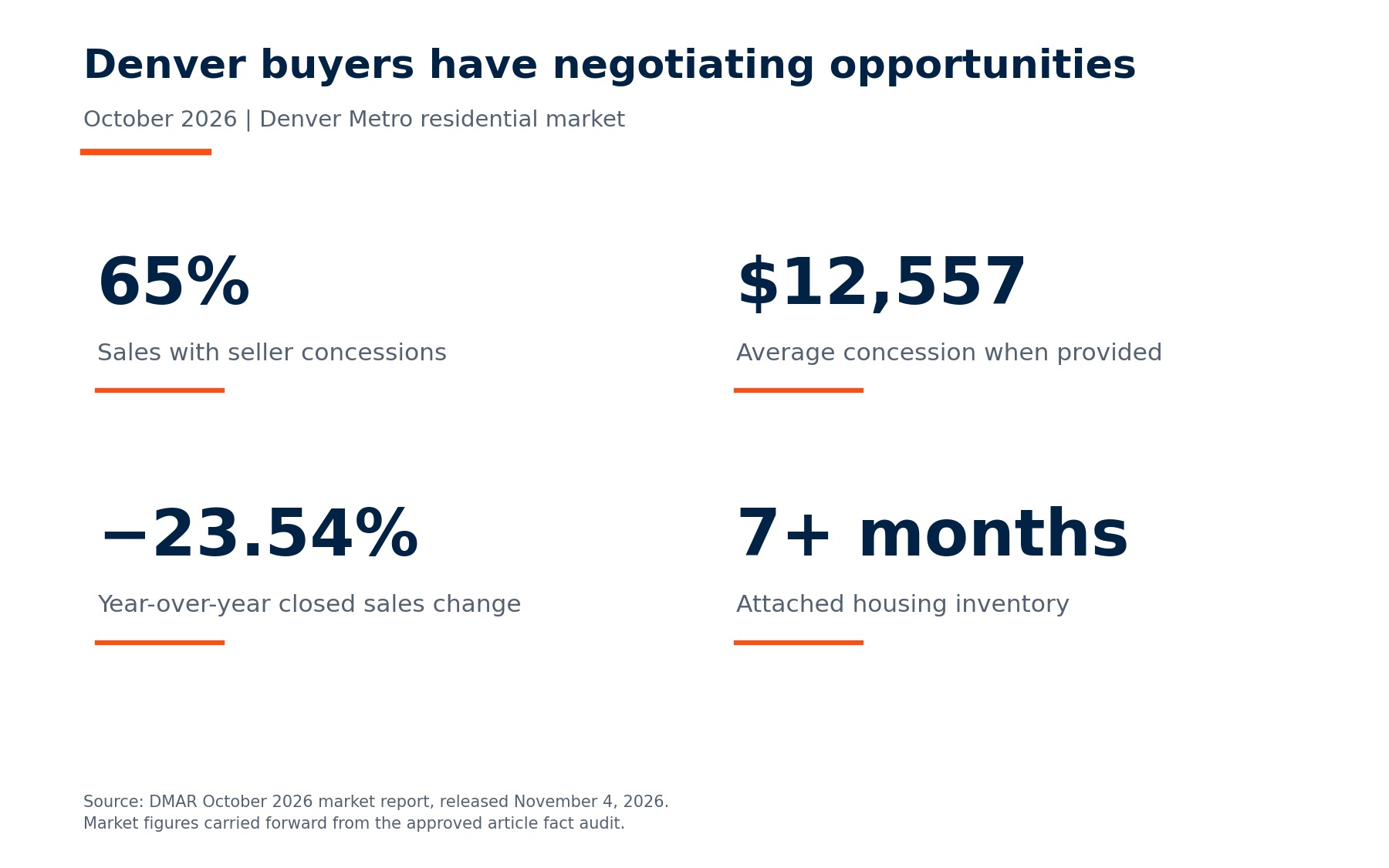
| Market indicator | October 2026 |
|---|---|
| Completed residential sales | 2,748 |
| Year-over-year change in sales | −23.54% |
| Sales involving seller concessions | 65% |
| Average concession among applicable sales | $12,557 |
| Attached housing inventory | More than 7 months |
Source: Denver Metro Association of Realtors — October 2026 Market Trends Report, released November 4, 2026.
Think about what that means if you're a buyer. If a property has been sitting on the market for three or four months, the homeowner has already reduced the price a couple of times and they're continuing to spend money carrying the property every month, there may be an opportunity to put together a transaction that works well for both parties.
That doesn't mean we can walk into every property in Broomfield, Arvada or Westminster and offer somebody $50,000 less than they're asking. Some properties are still selling relatively quickly because they're priced appropriately, they're in good condition and they're meeting the needs of the buyers looking in that particular market.
What it does mean is that we have more opportunities to evaluate properties, take our time, negotiate and make decisions based on the numbers rather than feeling like we have to make an offer before somebody else gets the house.
How much negotiating power do Denver homebuyers have right now?
Denver homebuyers may have opportunities to negotiate purchase prices, seller-paid closing costs, mortgage rate buydowns, repairs and closing arrangements. Properties that have experienced multiple price reductions or extended marketing periods may offer additional flexibility, although a successful negotiation depends on the property's value, competing offers and the seller's individual circumstances.

When I'm helping somebody purchase a property, I'm not just looking at the asking price. I want to know how long the house has been on the market, what it was originally listed for, whether there have been price reductions, what comparable properties have sold for and what else is currently available.
I also want to understand, to the extent that information is available, what the seller is trying to accomplish. Maybe they've already purchased another property and they're carrying two mortgages. Maybe they're relocating for a job. Maybe they're selling a house they inherited and they really don't want to spend another six months dealing with it.
Sometimes the biggest opportunity in a real estate transaction isn't necessarily negotiating the lowest possible purchase price. It may be putting together the terms of an offer in a way that addresses what the seller needs while also improving the financial situation for the buyer.
Here are some of the things we may be able to negotiate:
| Negotiation strategy | Potential benefit to the buyer |
|---|---|
| Lower purchase price | Reduce the amount paid for the property and potentially the mortgage balance. |
| Seller-paid closing costs | Preserve more of the buyer's available cash. |
| Permanent rate buydown | Reduce the mortgage payment over the life of the loan. |
| Temporary rate buydown | Reduce the buyer's initial out-of-pocket mortgage payments. |
| Inspection-related repairs or credits | Address repair expenses and property deficiencies. |
| Flexible closing arrangements | Reduce moving expenses or overlapping housing costs. |
The interesting thing is that two offers with the same purchase price can produce considerably different financial outcomes for the buyer. That's why I like to look at the entire transaction rather than simply focusing on how much we can get somebody to come down on the price.
Should I negotiate a lower price or ask for seller concessions?
A lower purchase price isn't always the most financially beneficial negotiation strategy for a homebuyer. Depending on the buyer's available cash, financing terms and anticipated ownership timeline, seller-paid closing costs or mortgage rate buydowns may provide greater benefits. Comparing the financial implications of each option helps determine which strategy makes the most sense.
Here's where things get interesting, particularly if you're working with a limited amount of cash. Let's say we've found a $600,000 house, and based on what we know about the property and the seller's situation, we're able to negotiate $15,000 in financial benefits. What do we do with that $15,000? Do we reduce the purchase price, have the seller pay our closing costs or use the money to buy down the interest rate?
There isn't necessarily one right answer. What I want to know is how much money you've got available, how much you want to have left in your bank account when we get this thing closed and how long you anticipate having that particular mortgage.
Let's run the numbers on four different negotiating strategies
For this example, we're assuming a $600,000 purchase price, a 20% down payment, a 30-year fixed mortgage at 7.28% and $15,000 in eligible closing costs and prepaid expenses.
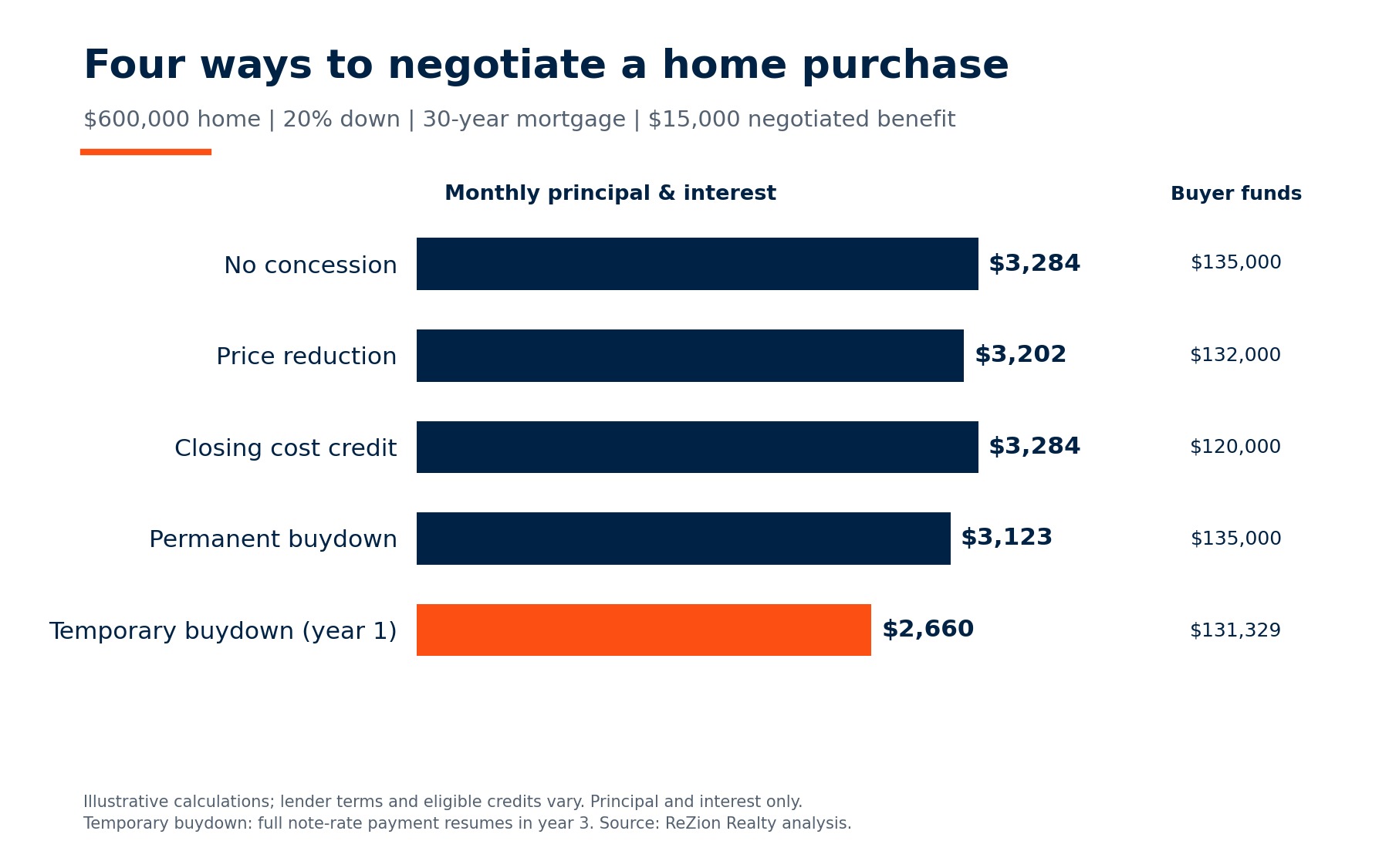
| Negotiating strategy | Estimated cash needed at closing* | Monthly principal and interest |
|---|---|---|
| No seller concession | $135,000 | $3,284 |
| $15,000 purchase price reduction | $132,000 | $3,202 |
| $15,000 closing cost contribution | $120,000 | $3,284 |
| Permanent rate buydown to 6.78% | $135,000 | $3,123 |
| Temporary 2-1 buydown with remaining credit applied to closing costs | $131,329 | $2,660 initially |
*Illustrative total buyer funds, before accounting for earnest money already deposited. The permanent rate buydown assumes a hypothetical lender quote. Actual rates, points, expenses and allowable credits vary. Temporary buydown payments increase after the first and second years.
Look at the difference between reducing the purchase price and having the seller pay your closing costs. By reducing the purchase price by $15,000, we've reduced your monthly principal and interest payment by approximately $82 and reduced the amount of cash you need at closing by $3,000.
But what if you're purchasing a house that needs some work, you're going to have moving expenses and you'd really like to have another $15,000 sitting in your bank account after closing? Having the seller pay those closing costs may put you in a much better financial position, even though your monthly mortgage payment is higher.
How does a temporary mortgage rate buydown work?
Another option we can evaluate is what's commonly referred to as a 2-1 buydown. Essentially, money is set aside to subsidize a portion of your mortgage payment during the first two years of the loan.
Using that same $480,000 mortgage with a permanent interest rate of 7.28%, here's approximately what your principal and interest payments would look like.
| Period | Equivalent payment rate | Monthly payment |
|---|---|---|
| First year | 5.28% | $2,660 |
| Second year | 6.28% | $2,965 |
| Third year and beyond | 7.28% | $3,284 |
In this example, the temporary buydown would require approximately $11,329 in funding, which would leave roughly $3,671 of the original $15,000 seller contribution available for other eligible closing expenses.
Important: A temporary buydown doesn't permanently reduce your mortgage rate.
The underlying note rate remains 7.28% in this example. Buyers need to be financially prepared to make the full payment when the temporary subsidy ends.
Now, I want to be very clear about something. Your actual mortgage note rate is still 7.28%. The money that's been set aside is simply subsidizing part of your payment for those first two years. I wouldn't want somebody purchasing a house based on their ability to afford the first-year payment if they're going to struggle to make the full payment when that subsidy goes away.
Under Fannie Mae's temporary interest rate buydown guidelines, eligible borrowers must qualify using the permanent note rate rather than the temporarily reduced payment.
A permanent rate buydown is another option. If we could use $15,000 to reduce the interest rate from 7.28% to 6.78%, we'd save approximately $161 a month in principal and interest. The simple payback period on that $15,000 would be approximately 7.7 years. If you're planning on refinancing or selling the property in three years, we may want to look at a different use of that money.
The actual cost of buying down a rate needs to come from a lender. The Consumer Financial Protection Bureau explains how discount points and lender credits work, including the relationship between upfront expenses and interest rates.
There are also limits to how much a seller can contribute. Under Fannie Mae's conventional financing guidelines, those limits generally range from 3% to 9% for primary residences and second homes, depending on the loan-to-value ratio. Investment properties generally have a 2% limit. Contributions cannot be used to satisfy the buyer's required down payment or financial reserves, and actual eligible expenses may further limit the amount.
This is where I want to get your lender involved, run through the different scenarios and figure out which option puts you in the best financial position.
Should I wait for mortgage rates to come down before buying?
Waiting for lower mortgage rates may reduce the monthly cost of buying a home, but future interest rates, property prices and negotiating conditions are uncertain. Buyers should compare several potential scenarios, including higher or lower home prices, while considering the cost of waiting and their ability to comfortably afford a mortgage today.
One of the things I hear frequently is that people are waiting for mortgage rates to come down before they purchase a house. Well, that may make perfect sense. But what I want to look at is what else could happen between now and the time those interest rates come down.
If mortgage rates decline considerably, we could see more buyers come back into the market, which could increase competition for available properties. Sellers may become less willing to negotiate, and property values could begin to recover. Of course, that's only one possible scenario. We could also see interest rates decline while property values continue to fall.
According to Freddie Mac's Primary Mortgage Market Survey, the national average 30-year fixed mortgage rate was 7.28% on November 19, 2026.
Let's assume we're looking at a $600,000 property today and that at some point in the future, mortgage rates decline to 6%. Here's what the numbers would look like under several different home price scenarios, assuming a 20% down payment.
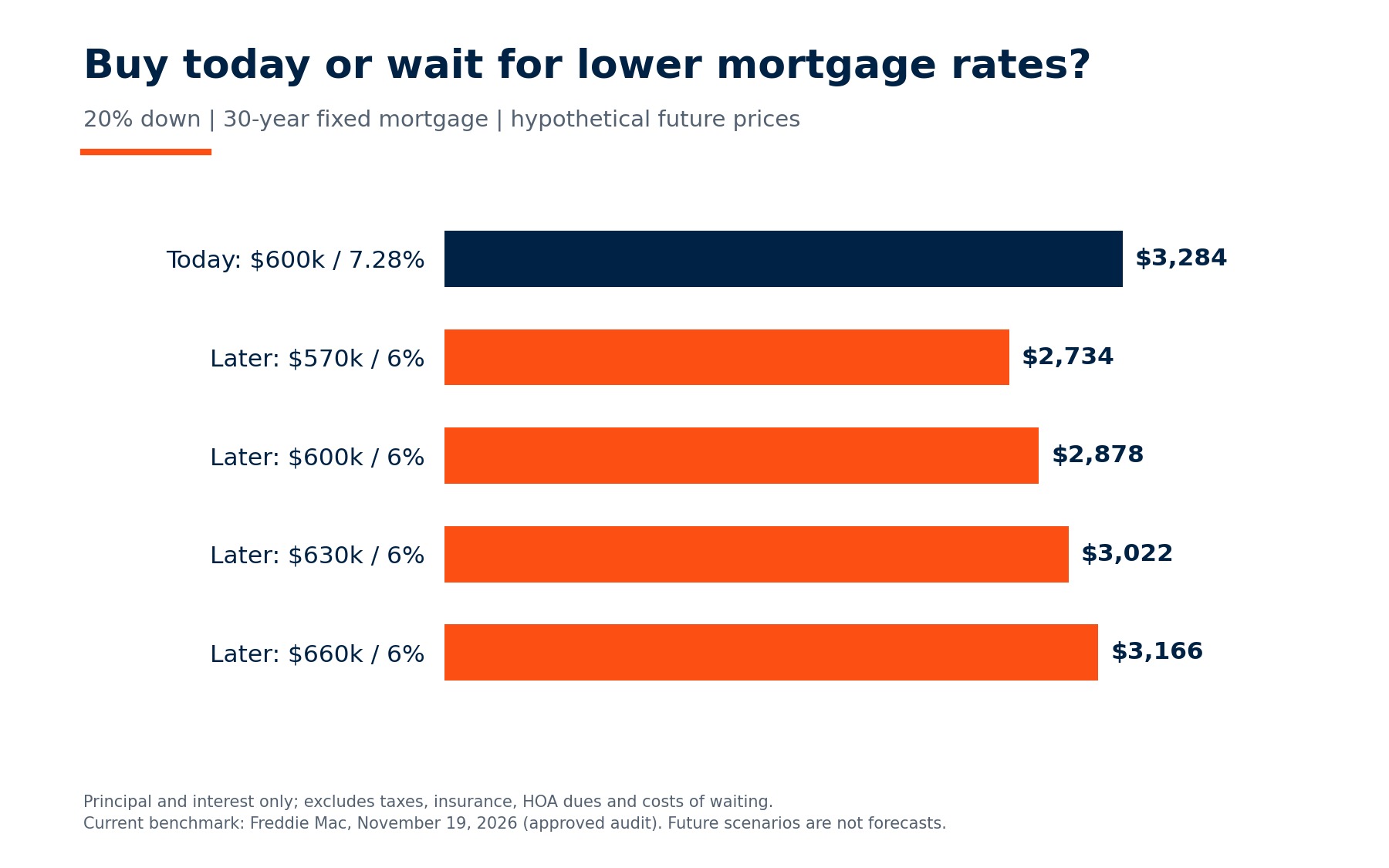
| Buying scenario | Purchase price | Interest rate | Monthly principal and interest |
|---|---|---|---|
| Buy today | $600,000 | 7.28% | $3,284 |
| Wait; prices decline 5% | $570,000 | 6.00% | $2,734 |
| Wait; prices remain unchanged | $600,000 | 6.00% | $2,878 |
| Wait; prices increase 5% | $630,000 | 6.00% | $3,022 |
| Wait; prices increase 10% | $660,000 | 6.00% | $3,166 |
Illustrative 30-year fixed mortgage calculations with 20% down. Future rates and prices are hypothetical, not market forecasts. Payments exclude property taxes, insurance, HOA dues and other ownership expenses.
What's interesting about this example is that even if the property increases in value by 10%, the monthly principal and interest payment would still be slightly lower if mortgage rates came down to 6%. Based strictly on the mortgage payment, the purchase price could increase to approximately $685,000 before you'd be looking at the same principal and interest payment you're looking at today.
But that's not the entire financial picture. If you're waiting another two years to buy a house, what are you spending on rent during that period? How much additional money will you need for a down payment if prices increase? What happens to your ability to negotiate with the seller? And what if mortgage rates don't come down?
On the other hand, if you purchase the property today and mortgage rates eventually decline, you may have the opportunity to refinance. But refinancing isn't free, and you'll still need to qualify for the new mortgage. If the property has declined significantly in value or your financial circumstances have changed, refinancing may not be as straightforward as you'd anticipated.
I'm not a big fan of somebody buying a house they can't comfortably afford today based on the assumption that they'll be able to refinance it in a year or two. If we can make the numbers work today and you're able to improve your financial situation by refinancing down the road, great. But I don't want that future refinance to be the thing that makes the purchase financially possible in the first place.
Related Reading — Article #3
Why Are Denver Homes Harder to Afford Even When Prices Are Falling?
What happens if I buy a house and Denver home prices continue to fall?
Buying a home in a declining market can expose buyers to equity losses, particularly when they make a small down payment or need to sell within a few years. A decline in property value doesn't necessarily create an immediate financial problem, but it can limit refinancing options and make an early sale more difficult.
Throughout this Denver Housing Market series, we've been talking about what's happened to property values since 2022. One of the things I want prospective buyers to understand is that just because a house is selling for less than it was worth a few years ago doesn't necessarily mean we've reached the bottom of the market.
Let's say you purchase a $600,000 home today, and over the next couple of years, that property declines another 10% in value. If you're comfortably making your mortgage payment and you're planning on living in that house for the next ten years, you may not be particularly concerned about what you could sell it for tomorrow.
But what happens if your employer transfers you out of state? What happens if your financial circumstances change and you need to get the house sold? That's when the amount of equity you've got in the property becomes extremely important.
How much protection does your down payment provide?
The following example assumes a $600,000 purchase price, eventual selling expenses of 6% of the resale price and no mortgage principal reduction for simplicity.
| Change in home value | 3% down | 5% down | 10% down | 20% down |
|---|---|---|---|---|
| No change | −$18,000 | −$6,000 | $24,000 | $84,000 |
| −5% | −$46,200 | −$34,200 | −$4,200 | $55,800 |
| −10% | −$74,400 | −$62,400 | −$32,400 | $27,600 |
| −15% | −$102,600 | −$90,600 | −$60,600 | −$600 |
| −20% | −$130,800 | −$118,800 | −$88,800 | −$28,800 |
Figures represent hypothetical proceeds or cash shortfalls after selling expenses and mortgage payoff. Actual commissions and selling expenses are negotiable. The example excludes principal reduction, mortgage insurance, financed fees and additional concessions.
$62,400 potential cash shortfall
A buyer who puts 5% down on a $600,000 home and experiences a 10% decline in property value could face this estimated shortfall if they need to sell under the assumptions above.
Let's look specifically at the buyer who puts 5% down. If the property declines 10% in value and that homeowner needs to sell, they could potentially be looking at a cash shortfall of more than $62,000 under these assumptions.
Now, that doesn't mean somebody putting 5% down shouldn't buy a house. What it means is that we need to have a conversation about how long they anticipate owning the property, what their financial situation looks like and how much flexibility they have if something changes.
I've also discussed the difference between a property's historical value and its current market value in Article #4 of this series.
Related Reading — Article #4
I think it's much better to understand these risks before we get to the closing table than to discover them a couple of years later when we're trying to figure out how to get somebody out of a difficult financial situation.
Is it cheaper to rent or buy a house in Denver right now?
Renting may be less expensive than buying a comparable Denver-area home in the short term, particularly when mortgage rates and ownership expenses are elevated. However, homeownership can provide long-term financial benefits through principal reduction and potential appreciation. The better financial decision depends on housing costs, ownership duration, investment alternatives and future market conditions.
I'll tell you, one of the things I don't particularly care for is the statement that renting is throwing your money away. You're paying for somewhere to live. When you purchase a house, you're also paying for somewhere to live, and a substantial portion of what you're spending every month isn't necessarily building equity in that property.
You're paying mortgage interest, property taxes, homeowners insurance and maintenance expenses. Depending on the type of property you're purchasing, you may also be paying several hundred dollars a month in HOA dues. None of those expenses directly reduces the amount you owe on the mortgage.
Now, there are certainly advantages to owning your own home. You have more control over the property, you're gradually paying down the mortgage and, over time, you may benefit from an increase in the property's value. But let's put some numbers behind the decision rather than simply assuming that buying is always the better financial option.
Comparing a $600,000 home purchase with renting
For this example, we're going to assume that we can either purchase a $600,000 home or rent a comparable property for $3,000 a month.
| Financial assumption | Amount |
|---|---|
| Home purchase price | $600,000 |
| Down payment | $120,000 |
| Estimated buyer closing costs | $15,000 |
| Mortgage interest rate | 7.28% |
| Mortgage term | 30 years |
| Monthly principal and interest | $3,284 |
| Monthly property taxes | $300 |
| Monthly homeowners insurance | $250 |
| Monthly maintenance allowance | $450 |
| Total monthly ownership budget | $4,284 |
| Starting monthly rent | $3,000 |
| Annual rent increases | 3% |
| Annual home appreciation | 2% |
| Eventual selling expenses | 6% |
These are hypothetical assumptions, not quotes for a specific property. For simplicity, we're holding the monthly ownership expenses constant, although taxes, insurance and maintenance costs may increase over time.
The Consumer Financial Protection Bureau provides additional guidance on budgeting for homeownership, including the upfront and ongoing expenses that buyers need to consider.
What happens over three, five and ten years?
| Financial comparison | 3 years | 5 years | 10 years |
|---|---|---|---|
| Total buyer cash outlay | $289,232 | $392,053 | $649,106 |
| Remaining mortgage balance | $465,075 | $453,158 | $414,572 |
| Estimated net equity after selling | $133,447 | $169,544 | $272,941 |
| Net cost of homeownership | $155,785 | $222,509 | $376,166 |
| Total rent paid | $111,272 | $191,129 | $412,700 |
Hypothetical financial model. Net homeownership cost includes initial buyer funds, ongoing ownership expenses and estimated proceeds from selling. Figures exclude tax benefits, investment returns and differences in utilities. Amounts are calculated using unrounded mortgage payments and rounded for display.
Under these particular assumptions, renting is considerably less expensive over three years and still less expensive over five years. By the time we get to ten years, buying the property produces a lower net housing cost after accounting for the estimated proceeds from selling the house.
But there's another piece of this equation that I think we need to look at. What happens to that $135,000 the renter didn't spend on a down payment and closing costs? And what happens to the difference between what they're spending on rent and what they would otherwise be spending on the house?
What if the renter invests the difference?
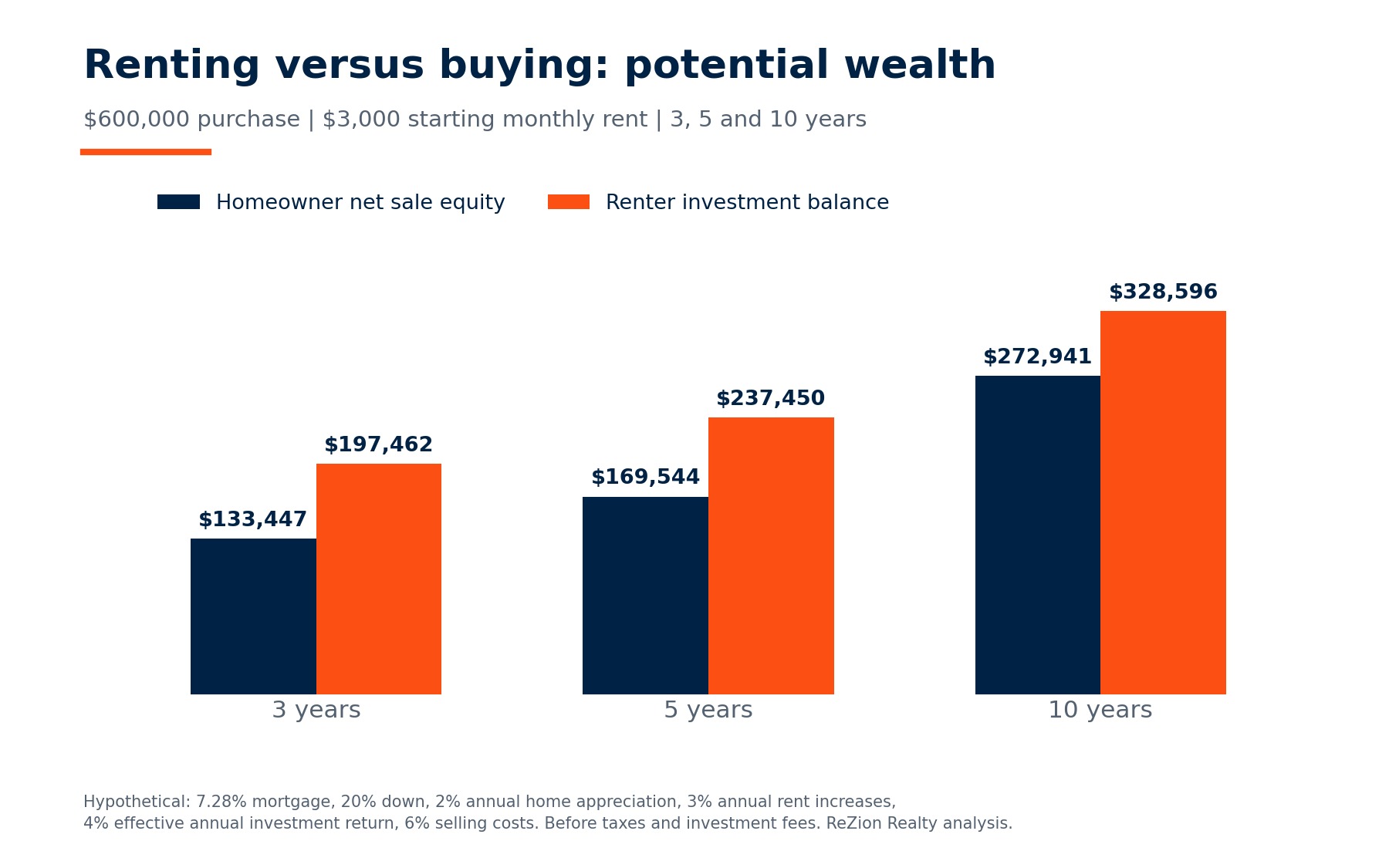
Let's assume the renter invests that initial $135,000 and continues investing the monthly difference between the cost of renting and owning the property, earning a hypothetical annual return of 4%.
| Potential accumulated wealth | 3 years | 5 years | 10 years |
|---|---|---|---|
| Homeowner's estimated net equity after selling | $133,447 | $169,544 | $272,941 |
| Renter's hypothetical investment balance | $197,462 | $237,450 | $328,596 |
| Difference favoring the renter | $64,015 | $67,906 | $55,655 |
Hypothetical 4% annual investment return before taxes and fees, with the initial $135,000 invested and monthly contributions made from the housing cost difference. Neither investment returns nor home appreciation is guaranteed.
That's a pretty interesting result. Even though buying the house produced a lower net housing cost over ten years, the renter could potentially have accumulated more wealth by investing the difference.
Of course, that assumes the renter actually has the discipline to invest the money rather than spend it. It also assumes the investments earn the projected return and the house appreciates at the rate we're using in the example. Change any of those numbers, and we could come up with a considerably different outcome.
There's also something to be said for the stability and control that come with owning your own home. If you've got a family and you've found a house you want to live in for the next fifteen years, your decision may involve considerations that aren't going to show up in a spreadsheet.
My point is that I don't want somebody purchasing a house simply because they've been told renting is a bad financial decision. Let's look at the numbers and determine what makes sense for their situation.
Is now a good time to buy a fixer-upper in Denver?
Buying a fixer-upper in Denver may provide an opportunity to acquire a property at a lower price and build equity through targeted improvements. However, the financial benefit depends on realistic renovation expenses, financing costs, unexpected repairs and the property's completed market value. A discounted purchase price alone doesn't guarantee a profitable renovation.
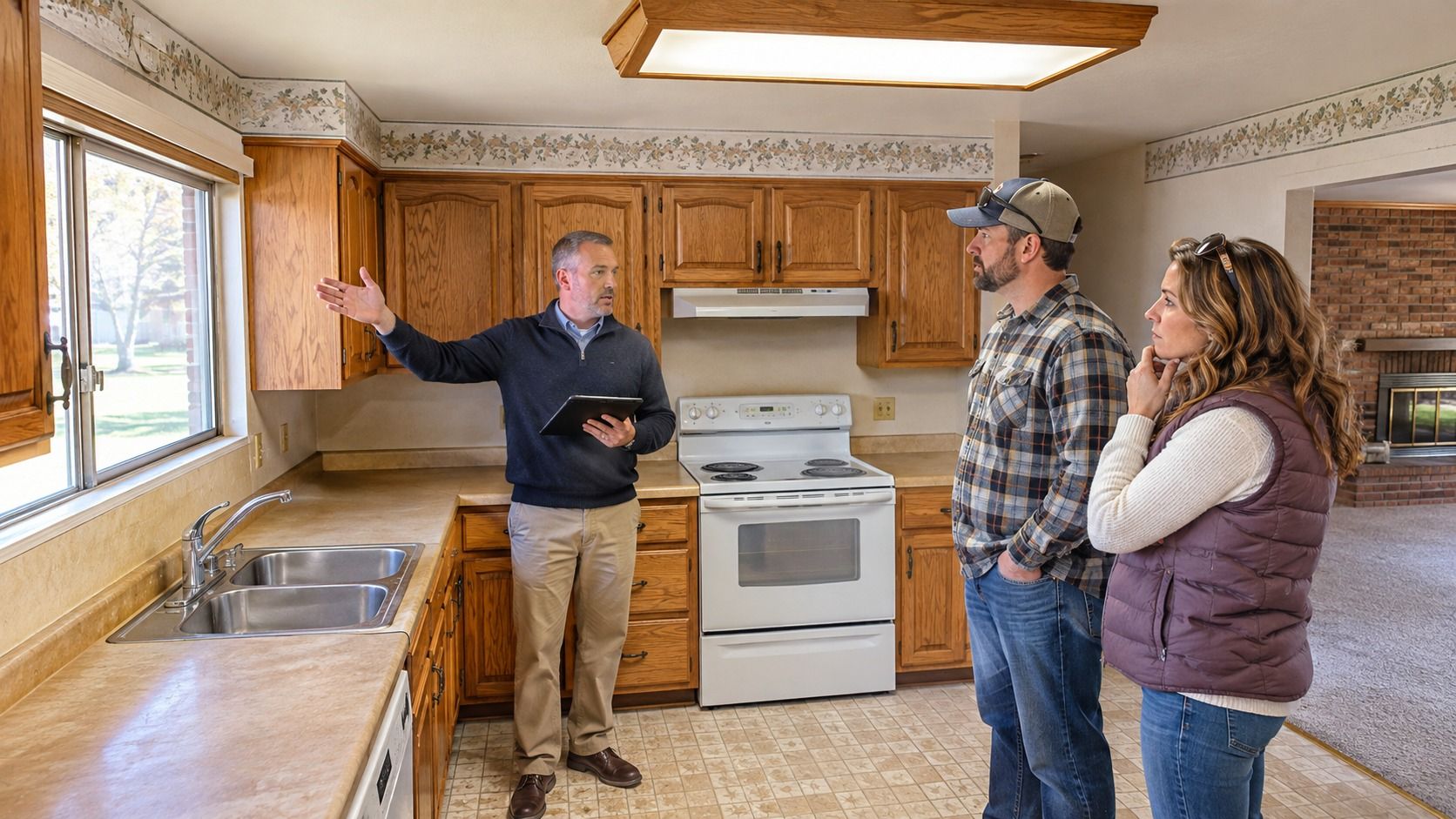
This is one of the things I really enjoy about helping people purchase real estate, particularly coming from a real estate investment and renovation background.
When I first got into real estate investing, I spent much of 2015 walking through and evaluating hundreds of properties. I was trying to figure out what different renovation projects would cost, what we could potentially sell those properties for once the work was completed and whether there was enough of a financial margin to make the investment worthwhile.
I'm a bit of a spreadsheet geek, and over the years I've continued developing those tools so I can evaluate properties from several different perspectives. Those same principles can be extremely useful when you're purchasing a house to live in.
Maybe we're looking at a neighborhood in Arvada or Broomfield, and the completely renovated houses are selling for approximately $650,000. We've identified a house that's structurally sound, subject to appropriate inspections, but the kitchen is dated, the bathrooms need some attention and the flooring needs to be replaced or refinished. If we can purchase that property for $550,000, is there an opportunity there?
Well, let's run the numbers.
Buying a renovated home versus buying and renovating
| Financial consideration | Renovated home | Dated home |
|---|---|---|
| Purchase price | $650,000 | $550,000 |
| Renovation budget | $0 | $50,000 |
| Renovation contingency | $0 | $7,500 |
| Additional project expenses | $0 | $5,000 |
| Estimated buyer closing costs | $16,250 | $13,750 |
| Total acquisition and project cost | $666,250 | $626,250 |
| Assumed completed market value | $650,000 | $650,000 |
Hypothetical example excluding mortgage interest and specific renovation financing expenses. Completed market value must be supported by comparable property sales and appropriate valuation.
$40,000 potential cost advantage
Purchasing and renovating the dated property could produce a lower total acquisition and project cost than purchasing an already renovated home under these assumptions.
In this example, we could potentially end up with a comparable property for $40,000 less by purchasing the dated house and doing the work ourselves through qualified contractors.
The other advantage is that you get to make some decisions about what goes into the property. Instead of paying a premium for somebody else's choice of kitchen cabinets, countertops and flooring, you may have the opportunity to make those selections yourself.
But I also want to make sure we're not buying ourselves a financial mess. What condition is the roof in? What's going on with the electrical and plumbing? Are there structural issues, drainage problems or expensive mechanical systems that need to be replaced? There's a significant difference between a house that needs a little spit shine and a house that's going to require a full gut renovation.
If you don't have the cash available to complete the renovations, there may be financing alternatives worth exploring. For example, Fannie Mae's HomeStyle Renovation mortgage program allows eligible borrowers to finance qualifying renovation expenses along with a property purchase or refinance. These programs have specific lender, property, contractor and appraisal requirements that need to be evaluated.
What I like to do is walk through the property, identify what needs to happen, put together realistic cost estimates, evaluate what comparable renovated properties are selling for and determine whether there's actually an opportunity to create equity. If it makes sense to move forward, I can also help coordinate the work.
I don't want to spend $75,000 renovating a property if we're only going to increase its value by $40,000. Unless you're comfortable spending the additional money for your own enjoyment, that doesn't make a whole lot of financial sense.
Is now a good time to sell my current home and buy a different one?
A declining housing market can create opportunities for homeowners who are moving into more expensive properties because the dollar difference between the two homes may decrease. However, downsizing homeowners may experience the opposite effect. Existing mortgage rates, available equity, transaction expenses and new financing costs must also be evaluated before making a decision.
I've spent quite a bit of time talking with homeowners about what's happened to the value of their properties since 2022. Something that doesn't always get considered in those conversations is what's happened to the value of the property they would like to purchase next.
Let's say you're currently living in a house that was worth $600,000, and you've been thinking about moving into a larger house that was worth $900,000. If both of those properties decline 10% in value, here's what happens.
Moving up in a declining housing market
| Financial comparison | Before the decline | After a 10% decline |
|---|---|---|
| Current home's value | $600,000 | $540,000 |
| Desired home's value | $900,000 | $810,000 |
| Price difference | $300,000 | $270,000 |
You've lost $60,000 in value on your current house, which certainly isn't something you're excited about. But the house you'd like to purchase has lost $90,000 in value. So, the price difference between those two properties has actually decreased by $30,000.
Does that mean you should automatically sell your house and purchase the other one? Not necessarily. If you've currently got a mortgage at 3% and we're looking at financing the next property at considerably more than that, we need to figure out what that's going to do to your monthly housing expenses.
For somebody who's downsizing, we may be looking at a different situation.
Downsizing in a declining housing market
| Financial comparison | Before the decline | After a 10% decline |
|---|---|---|
| Current home's value | $900,000 | $810,000 |
| Desired home's value | $600,000 | $540,000 |
| Gross price difference | $300,000 | $270,000 |
In this example, the homeowner has $30,000 less in gross property value available to release through the transaction. That may be particularly important if the homeowner is looking to pull equity out of the property to help fund retirement or pay for independent living or assisted living.
These examples assume both properties decline by the same percentage, which may not happen in the real world. Different neighborhoods, price ranges and property types can perform quite differently. The comparisons also exclude mortgage payoffs, transaction expenses and changes in financing costs.
This is another situation where I don't want to focus exclusively on what somebody's current house is worth. I want to look at what they're trying to accomplish, what they're going to walk away with from the sale, what the next property is going to cost and what their financial situation is going to look like when everything is said and done.
I'll be going into considerably more detail about the selling side of that decision in Article #7 of this series, where we'll evaluate whether it makes more sense to sell your Denver home today or wait for a potential market recovery.
Who should buy a house in Denver right now, and who should wait?
Buying a home today may make sense for people with stable income, manageable housing expenses, adequate financial reserves and a longer anticipated ownership timeline. Waiting may be preferable for buyers facing employment uncertainty, limited savings, potential relocation or financial dependence on future mortgage rate reductions. Personal readiness matters more than attempting to time the market.

I don't think there's a particular mortgage rate or a particular point in the real estate market where it suddenly makes sense for everybody to buy a house. Every one of these situations is different, and there are things going on in people's lives that may be considerably more important than what's happening in the housing market.
Maybe you've been renting for several years, you've accumulated a substantial down payment and you've finally found a house in a neighborhood where you want to live for the foreseeable future. If we can negotiate a reasonable purchase price and put together financing that you're comfortable with, there may be some very good reasons to move forward.
On the other hand, maybe you're stretching financially just to come up with a down payment, you're going to have very little money left after closing and you're not entirely sure where you're going to be working two years from now. Even if we find a pretty good deal on a house, purchasing that property may not be the best thing for you to do right now.
| Buying now may make sense if... | Waiting may make sense if... |
|---|---|
| Your income is reasonably stable. | Your employment or income is uncertain. |
| You can comfortably afford the full mortgage payment today. | You're depending on lower future mortgage rates. |
| You'll have adequate financial reserves after closing. | Purchasing would exhaust your savings. |
| You anticipate owning the property for several years. | You may need to relocate relatively soon. |
| You've identified a competitively priced property. | You haven't found a property that meets your needs. |
| You understand the property's repair and maintenance requirements. | Unexpected repairs would put you in financial distress. |
| You can tolerate potential fluctuations in property value. | Losing equity could create significant financial problems. |
The CFPB's guidance on the financial considerations of buying a home is a useful starting point for evaluating your financial readiness.
At the end of the day, I would much rather help somebody determine that they need to wait another year before purchasing a house than get them into a property that's going to put them in a difficult financial situation.
How do I know if buying a particular Denver home makes financial sense?
Determining whether a home purchase makes financial sense requires evaluating the property's current value, condition, financing expenses, negotiating opportunities and anticipated ownership costs. Buyers should also compare alternatives, including renting, waiting or purchasing a property requiring improvements, to determine which option best supports their long-term financial and personal objectives.
If you're thinking about purchasing a house, what I'd really like to do is sit down with you before we start driving around looking at properties. I want to understand what's happening in your life, what you're trying to accomplish and what you want your financial situation to look like once we've purchased the property.
Then we can start looking at the different options available to you. Maybe we find a house that's been sitting on the market for several months and we're able to negotiate a purchase price and seller concessions that put you in a good financial position. Maybe we find a property that needs some work, and by the time we get it cleaned up and renovated, you've potentially created some additional equity.
Or maybe we run the numbers and determine that you really ought to continue renting for a while, build up your savings and revisit the purchase when your financial situation is a little different. I'm perfectly comfortable having that conversation with somebody.
What I enjoy about real estate is that I can bring my investment experience, renovation background and understanding of the financial mechanics of a transaction together to help people evaluate options they may not have otherwise considered. I don't necessarily want to find you the least expensive house. I want to help you find the property and put together the transaction that makes the most sense for what you're trying to accomplish.
I don't necessarily want to convince you that now is a good time to buy a house. I want to help you determine whether now is a good time for you to buy a house.
If you're considering purchasing a home in Broomfield, Arvada, Westminster, Thornton or anywhere in the Denver Metro area, give me a call. Let's sit down, figure out your options and run the numbers.
Scott Jensen
ReZion Realty | Brokered by eXp Realty
Broomfield, Colorado | Serving Denver Metro
Phone: 720-352-7704
Email: scott@rezion.us
People first, contents second, real estate last.
Continue Reading the Denver Housing Market Series
I've put together this series to help Denver-area homeowners and prospective buyers better understand what's happening in our housing market and how those changes may affect their financial decisions.
- Article #1 — Is Inflation Driving Denver Home Prices Down?
- Article #2 — How Much Value Have Denver Homes Really Lost Since 2022?
- Article #3 — Why Are Denver Homes Harder to Afford Even When Prices Are Falling?
- Article #4 — Why Is My Denver Home Worth Less Than Its Appraised Value?
- Article #5 — Why Are So Many Denver Homes Expiring Without Selling?
- Article #6 — Is Now a Good Time to Buy a House in Denver? (You are here.)
- Coming next: Article #7 — Should I Sell My Denver Home Now or Wait for Prices to Recover?
- Article #8 — How Do You Know When Buying or Selling a Denver Home Makes Financial Sense?
Research Sources
- Denver Metro Association of Realtors — October 2026 Market Trends Report
- Freddie Mac — Primary Mortgage Market Survey
- Fannie Mae — Interested Party Contributions
- Fannie Mae — Temporary Interest Rate Buydowns
- Fannie Mae — HomeStyle Renovation Mortgages
- Consumer Financial Protection Bureau — Discount Points and Lender Credits
- Consumer Financial Protection Bureau — Owning a Home
Market information reflects reporting available as of the November 24, 2026 fact audit. All financial scenarios are illustrative and do not represent guaranteed property values, mortgage rates, investment returns or actual client transactions. Financing terms, property expenses, commissions and fees vary. Consult appropriate mortgage, financial, tax and legal professionals regarding your individual circumstances.
Categories
Recent Posts