
Why Are So Many Denver Homes Expiring Without Selling?
Denver Housing Market Series | Part 5 of 8 | By Scott Jensen
More Denver homes are expiring without selling because homeowners are competing against more available properties, fewer completed transactions and buyers whose purchasing power has been significantly reduced by higher mortgage rates. Sellers who don't adjust their pricing, property preparation and marketing strategies to today's conditions may find themselves sitting on the market for months.

Imagine you've had your home on the market for six months. You've been keeping the house clean for showings, you've reduced the price a couple of times, and for whatever reason, you still haven't received an offer that makes financial sense. Now your listing has expired, and you're trying to figure out what to do next. Do you hire another agent, reduce the price again, put some money into the property or just take it off the market and wait?
Before we make any of those decisions, I want to look at what's actually happening in the Denver housing market, because the market we're dealing with today is considerably different from the one we were dealing with in 2022. Once you understand what's changed, we can start figuring out what makes sense for your particular situation.
I've put together some numbers that I think will help explain why so many homeowners are struggling to get their homes sold. More importantly, I want to walk you through some of the options you have and how those different options can affect what you ultimately walk away with.
How many Denver homes are expiring without selling?
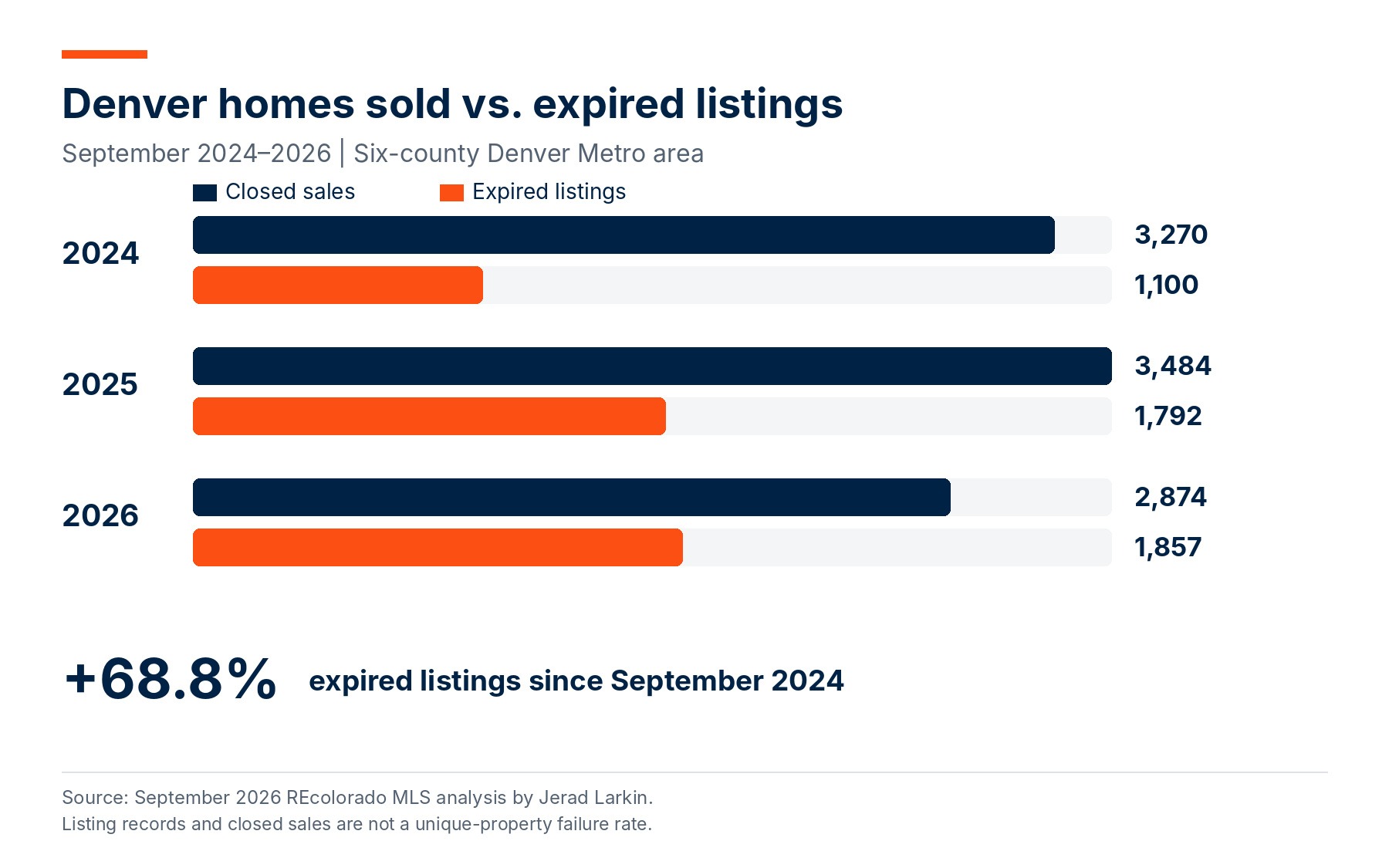
In September 2026, approximately 6.5 residential listings expired for every 10 homes that sold across six Denver Metro counties. In September 2024, that figure was just 3.4. While an expired listing doesn't necessarily mean a home will never sell, the comparison demonstrates how much more challenging today's market has become.
I came across some interesting research compiled from REcolorado MLS data that compares the number of residential properties sold with the number of expired listings across six Denver Metro counties. What I particularly like about this data is that we're comparing the same month over three consecutive years, rather than comparing different times of the year when normal seasonal fluctuations could distort the picture.
| September | Homes sold | Expired listings | Expired per 10 sales |
|---|---|---|---|
| 2024 | 3,270 | 1,100 | 3.4 |
| 2025 | 3,484 | 1,792 | 5.1 |
| 2026 | 2,874 | 1,857 | 6.5 |
Source: Denver Metro Expired Listings Report — September 2026. Analysis covers Adams, Arapahoe, Broomfield, Denver, Douglas and Jefferson counties.
Think about what happened over those two years. The number of expired listings increased by nearly 69%, while the number of completed transactions actually declined. In other words, we're seeing considerably more listings expire relative to the number of properties that are getting sold.
Now, I want to be careful about how we interpret these numbers. An expired listing means that particular listing agreement ended; it doesn't necessarily mean the property will never sell. Some of these homes will come back on the market with a different price, a different agent or a different marketing strategy and eventually get sold. We're comparing listing records and completed transactions, not calculating the percentage of individual homeowners who will ultimately be unable to sell their homes.
Nevertheless, the direction these numbers are moving is something I think every homeowner considering selling should pay attention to.
How has the Denver housing market changed since 2022?
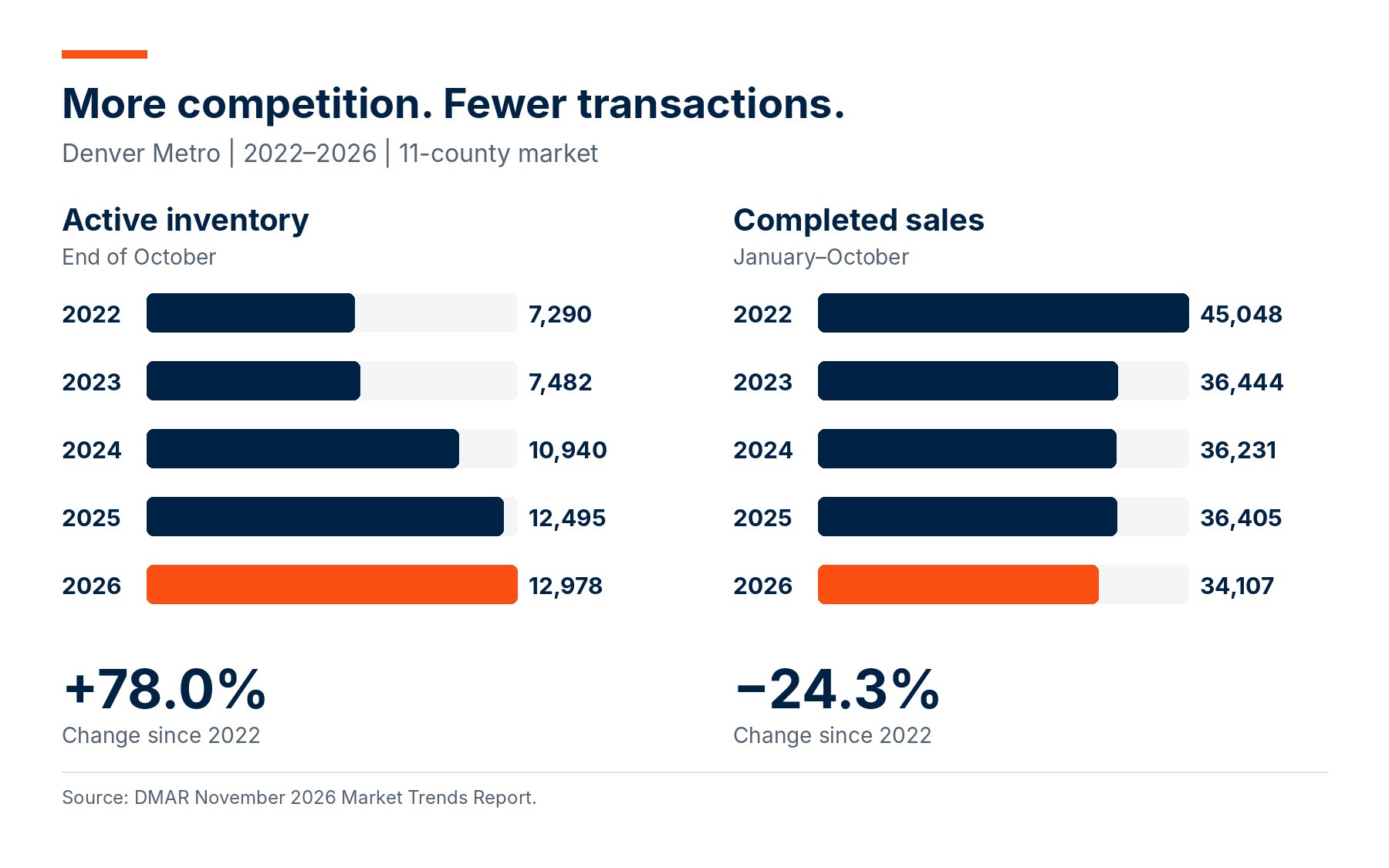
Denver Metro homeowners are competing in a market with substantially more available inventory and fewer completed transactions than in 2022. By October 2026, active residential listings had increased approximately 78% compared with October 2022, while year-to-date closed sales had declined approximately 24%. Buyers have more choices, and sellers have more competition.
To understand why we're seeing more listings expire, I think we need to look at what's happened to the overall housing market since 2022. The Denver Metro Association of Realtors' November 2026 Market Trends Report gives us a good opportunity to do that because it provides several years of historical data across an 11-county region.
Take a look at what's happened to the number of homes available for sale and compare that with the number of homes actually selling.
| Year | October active listings | January–October sales |
|---|---|---|
| 2022 | 7,290 | 45,048 |
| 2023 | 7,482 | 36,444 |
| 2024 | 10,940 | 36,231 |
| 2025 | 12,495 | 36,405 |
| 2026 | 12,978 | 34,107 |
Source: Denver Metro Association of Realtors — November 2026 Market Trends Report.
We've gone from approximately 7,300 homes available for sale at the end of October 2022 to nearly 13,000 in October 2026. At the same time, we've gone from more than 45,000 completed transactions through October to just over 34,000. That doesn't mean today's inventory is at unprecedented historical levels, but it certainly means sellers have considerably more competition than they had in 2022.
Back when inventory was extremely limited, buyers frequently had to make compromises. Maybe the kitchen was dated, the carpet needed replacing or the backyard needed some work. If there weren't many other homes available, the buyer might have been willing to take on those projects just to get into a house. Today, that same buyer may have several other properties to choose from that are similarly priced and don't require nearly as much work.
So, when I walk through a property with a homeowner today, I'm not just looking at the house itself. I'm thinking about what a buyer is going to see when they walk through this house compared with the other five or six homes they may be looking at. Where does our property fit into that equation, and what do we need to do to make it competitive?
More competition and fewer transactions. That's the market we're working in today.
Why do market reports say homes are selling in 30 days when mine has been listed for months?
The median days on market reported in many real estate market reports reflects homes that successfully sold, not every home listed for sale. Properties that remain active, expire or are withdrawn tell a different story. Looking only at successful transactions can create unrealistic expectations about how quickly a particular home should sell.
This is one of the things I find particularly interesting about reading real estate market reports. According to the October 2026 market data in DMAR's November report, the median number of days in MLS for sold residential properties actually decreased from 33 days in October 2025 to 30 days in October 2026. Well, if you just looked at that one number, you might think the market is improving for sellers. But when you start looking at some of the other numbers, you get a very different picture.
| Market indicator | Oct. 2025 | Oct. 2026 | Change |
|---|---|---|---|
| Active listings | 12,495 | 12,978 | +3.9% |
| Closed sales | 3,594 | 2,748 | −23.5% |
| Pending sales | 3,216 | 2,562 | −20.3% |
| Median sold price | $590,000 | $595,000 | +0.8% |
| Median days in MLS | 33 | 30 | −9.1% |
Source: DMAR November 2026 Market Trends Report.
We're seeing significantly fewer transactions, yet the homes that successfully sell are moving slightly faster. The important distinction is that the median days in MLS statistic is based on properties that actually sold. It isn't telling us what happened to all the properties that have been sitting on the market for three, four or six months and still haven't sold.
Now consider a separate analysis of the six core Denver Metro counties in early November 2026. When we look specifically at the properties that are still available for sale, the numbers tell us something quite different.
What's happening to homes that haven't sold?
Among 12,085 active residential listings:
- 34% had been on the market for more than 90 days.
- 60% had experienced at least one price reduction.
- 63 days was the median time on market among active listings.
Source: Jerad Larkin's October 2026 REcolorado MLS analysis.
That same six-county analysis recorded 1,945 expirations and 602 withdrawals during October, compared with 2,754 completed sales. That's another important piece of the puzzle when we're trying to understand what sellers are experiencing.
| Listing outcome | Number of records |
|---|---|
| Closed sales | 2,754 |
| Expired listings | 1,945 |
| Withdrawn listings | 602 |
Counts represent listing records, not mutually exclusive groups of unique properties. This analysis uses different geographic boundaries and extraction dates than the DMAR report. Source: Denver Metro Housing Market — October 2026.
When I'm evaluating a property for a homeowner, I want to look at the homes that successfully sold, but I also want to look at the homes that didn't sell. What were they originally priced at? How long were they on the market? How many times did they reduce the price, and how did the condition of those properties compare with the ones that actually got sold? There's a lot we can learn from looking at both sides of that equation, particularly when we're trying to avoid repeating somebody else's unsuccessful selling strategy.
Are Denver homeowners still pricing their homes like it's 2022?
Some Denver homeowners continue to base their asking prices on previous appraisals, peak market values or what neighboring homes sold for several years ago. Those figures provide historical context, but today's market value depends on current competition, recent comparable sales, property condition and what buyers are willing and able to pay now.

I completely understand why homeowners have a difficult time adjusting their expectations. Let's say your neighbor sold their house for $700,000 in 2022, and you've got a nicer kitchen, a finished basement and a considerably larger lot. You naturally assume your house should be worth at least what theirs sold for, if not more. The problem is that the economic conditions under which your neighbor sold their house are not the same conditions we're dealing with today.
The same thing applies to an appraisal you had done a couple of years ago, your county property tax assessment or the estimated value you're seeing online. Those numbers can be useful pieces of information, but none of them necessarily tells us what we're going to get for the house if we put it on the market today. I went into considerably more detail about that in the previous article in this series.
Related Reading — Article #4
When I price a property, I'm looking at recently closed comparable properties, what's currently available for sale, what's under contract and what hasn't sold. I'm also evaluating the condition of those properties compared with yours, because there may be a significant difference between what a completely renovated house is selling for and what a house that needs a fair amount of work is selling for.
What your house was worth in 2022 is interesting information, but what I need to figure out is what we can realistically sell it for today. Once we establish that, we can start putting some numbers behind the different options available to you.
Why aren't buyers making offers even when home prices have fallen?
Higher mortgage rates have substantially increased the monthly cost of purchasing a home, even when the purchase price remains unchanged or declines. Buyers must also account for property taxes, homeowners insurance, HOA dues and maintenance. A home that appears reasonably priced to a seller may simply be unaffordable to many prospective buyers.
Here's the thing. When you're selling a house, you're typically thinking about the purchase price and how much equity you're going to pull out of the property. When a buyer is looking at that same house, particularly if they're financing the purchase, they're thinking about how much it's going to cost them every month. Those are two very different financial considerations, and the difference has become much more significant over the last several years.
According to Freddie Mac, the national average 30-year fixed mortgage rate was 3.22% on January 6, 2022. On November 19, 2026, it was 7.28%. Let's run the numbers on a hypothetical $600,000 home, assuming the buyer puts 20% down and finances the remaining $480,000.
| Financial comparison | January 2022 | November 2026 |
|---|---|---|
| Purchase price | $600,000 | $600,000 |
| Down payment | $120,000 | $120,000 |
| Loan amount | $480,000 | $480,000 |
| Interest rate | 3.22% | 7.28% |
| Approximate monthly principal and interest | $2,081 | $3,284 |
Approximately $1,200 more per month
That's nearly a 58% increase in monthly principal and interest payments for the same home at the same purchase price.
Illustrative 30-year fixed mortgage calculations. Excludes property taxes, homeowners insurance, HOA dues, points and other financing expenses. Source: Freddie Mac Primary Mortgage Market Survey.
We're talking about the same house at the same purchase price, but the buyer is spending approximately $1,200 more every month just on principal and interest. That's before we start factoring in property taxes, insurance, HOA dues or anything else associated with owning that property. For a lot of households, finding an additional $1,200 every month is a significant financial hurdle.
At those mortgage rates, somebody who could afford the principal and interest payment on a $600,000 house in early 2022 would have a purchasing budget of approximately $380,000 today, assuming the same down payment percentage and loan term. That's approximately 37% less mortgage purchasing power. I'm certainly not suggesting that your $600,000 home should suddenly be worth $380,000, because there are numerous other factors that affect property values, including household incomes, cash buyers, available inventory and local demand. What it does help explain is why the pool of buyers able to purchase your property may be smaller than it was a few years ago.
If you want to understand more about how home prices and housing affordability can move in different directions, I walked through that in Article #3 of this series.
Related Reading — Article #3
Why Are Denver Homes Harder to Afford Even When Prices Are Falling?
Why are some Denver homes selling while others sit on the market?
Homes that are competitively priced, well presented and appropriately marketed can still sell relatively quickly in today's Denver housing market. However, the competition varies significantly by location, property type, price range and condition. Sellers need to understand their home's specific competition rather than relying exclusively on regional housing market averages.
One of the challenges with talking about the Denver housing market is that we're not really talking about one market. A single-family home in Broomfield is competing in a different environment than a condominium in downtown Denver. A completely renovated ranch home in Arvada may have a different pool of prospective buyers than a home in Thornton that needs $50,000 worth of work. Even within the same neighborhood, two houses that look fairly similar on paper can have very different selling experiences.
Take a look at some of the differences we're seeing between detached and attached properties in the October 2026 DMAR data.
| Market indicator | Detached homes | Attached homes |
|---|---|---|
| Active listings | 8,779 | 4,199 |
| Closed sales | 2,170 | 578 |
| Median sold price | $645,000 | $375,000 |
| Median days in MLS | 26 days | 48 days |
| Average days in MLS | 45 days | 69 days |
| Sold-to-list-price ratio | 98.55% | 97.69% |
| Median sold price change year over year | −0.64% | −3.25% |
Source: DMAR November 2026 Market Trends Report.
If we're selling an attached property, there may be some additional considerations we need to factor into the equation. What are the monthly HOA dues? What's happening with the association's insurance? Are there any potential special assessments or financing issues we need to be aware of? All of those things can affect what a buyer is willing or able to pay for a property.
Regardless of what type of property we're selling, there are generally five areas I want to evaluate when a home isn't getting sold:
- Pricing: Where are we priced compared with the other properties buyers are looking at?
- Condition: What is a buyer going to have to spend on the property after purchasing it?
- Presentation: Does the house show well in the photographs and when somebody actually walks through the door?
- Marketing: Are we getting the property in front of prospective buyers and adequately communicating what the house has to offer?
- Accessibility: Are we making it reasonably convenient for qualified buyers to get in and see the property?
Sometimes there's one glaring issue that needs to be addressed, and sometimes it's a combination of several smaller issues. What I don't want to do is automatically start reducing the price or spending money on renovations without first understanding what the problem is. We may be able to address the issue for considerably less money than the homeowner anticipated, but we need to figure out what we're dealing with first.
How much does it cost to keep an overpriced home on the market?
Keeping a home on the market for additional months can reduce the homeowner's eventual financial return through mortgage interest, taxes, insurance, utilities, maintenance, price reductions and seller concessions. A higher initial asking price does not necessarily result in a higher sale price or more money in the homeowner's bank account.
One of the biggest things I want homeowners to understand is that the sale price of the house isn't necessarily the most important number. What I really want to know is what they're going to walk away with when everything is said and done. We can sell a house for more money, but if it costs us considerably more money to get it sold, have we actually accomplished anything financially?
One of the more interesting findings in the six-county October 2026 market analysis was the difference between the original asking price, the eventual sale price and the concessions provided to buyers. Take a look at how that combined number changes between properties that sold relatively quickly and properties that sat on the market for several months.
| Time on market | Median combined price difference and concessions |
|---|---|
| First 7 days | $5,000 |
| 91–180 days | $65,250 |
Source: October 2026 REcolorado MLS analysis by Jerad Larkin. This comparison shows an association, not proof that additional time on the market caused the entire difference.
Now, we can't necessarily attribute that entire difference to the amount of time those properties spent on the market. Some of those houses may have been substantially overpriced from the beginning. But what we also need to consider is that these numbers don't account for the money homeowners may have spent carrying those properties while they were waiting for them to sell.
Two comparable homes. Two different pricing strategies.
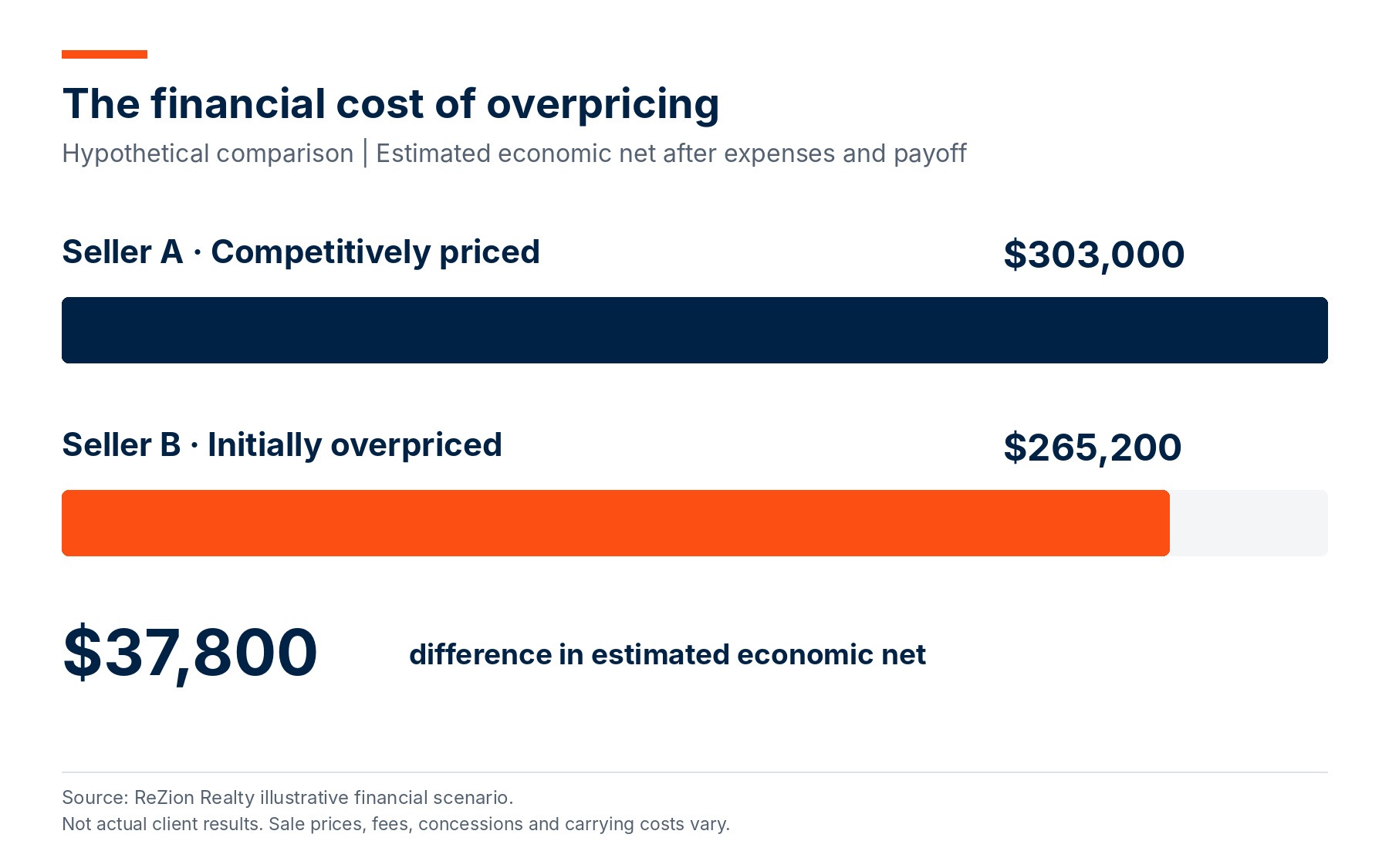
Let's put together a hypothetical example involving two homeowners with comparable properties and a remaining mortgage balance of $250,000 each. Seller A wants to get the house sold and prices it competitively from the beginning. Seller B would really like to get another $40,000 for the property and decides to test the market at a higher price. After several months and multiple price reductions, Seller B eventually accepts an offer.
Let's run the numbers and see what each homeowner actually ends up with.
| Financial comparison | Seller A | Seller B |
|---|---|---|
| Original asking price | $610,000 | $650,000 |
| Final sale price | $600,000 | $580,000 |
| Time until closing | 2 months | 6 months |
| Carrying expenses | $6,000 | $18,000 |
| Buyer concessions | $5,000 | $12,000 |
| Selling expenses* | $36,000 | $34,800 |
| Mortgage payoff | $250,000 | $250,000 |
| Estimated economic net | $303,000 | $265,200 |
*This example assumes $3,000 per month in non-equity-building carrying expenses, selling expenses of 6% and a constant mortgage payoff for simplicity. Actual commissions and fees are negotiable. Economic net accounts for expenses incurred before closing. These are hypothetical scenarios, not actual client transactions.
Look at what happened in this example. Seller B started out wanting $40,000 more for the house, but after factoring in the lower final sale price, the additional carrying expenses and the concessions provided to the buyer, that homeowner actually walked away with nearly $38,000 less than Seller A.
Now, could Seller B have found somebody willing to pay $650,000? Possibly. Could the market have improved over those six months? Absolutely. But it could have gone the other direction as well, and those are the things I want to put some numbers behind before we make a decision about how to price the house. I'm not opposed to trying to maximize the value of a property. That's exactly what I'm trying to accomplish. I just want to make sure that we're maximizing what the homeowner ultimately walks away with, not simply chasing a higher sale price.
Should I lower my asking price, renovate my home or sell it as-is?
The best strategy depends on the home's condition, current market value, available funds, selling timeline and expected net proceeds. A price reduction may be appropriate in some situations, while targeted improvements could produce a better financial outcome in others. A full renovation or direct investor sale may also deserve consideration.

This is actually one of my favorite parts of what I do. Coming from a real estate investment and renovation background, I've spent years developing spreadsheets that allow me to look at a property from several different perspectives. When I walk through a house, I'm not just thinking about what I can sell it for in its current condition. I'm also thinking about what we could potentially sell it for if we did some work to the property, how much that work would cost, how long it would take and whether the homeowner would actually come out ahead.
Maybe it makes sense to completely renovate the property. Maybe we don't need to go quite that far, and we just need to bring it up to the standards of the other houses in the neighborhood. Or maybe the house just needs a little spit shine. We get the contents out, get the house cleaned up, refinish the hardwood floors, put some fresh paint on the walls and get this thing on the market. In some situations, selling directly to an investor may be the best option based on what the homeowner needs to accomplish.
What I want to do is put all of those options side by side and figure out what each one looks like financially.
Five different ways to sell the same Denver-area home
For this hypothetical example, let's assume we have a dated property with a remaining mortgage balance of $250,000. We're going to look at five different scenarios, ranging from a complete renovation to a direct investor sale. Each scenario has a different projected sale price, preparation expense, carrying expense and potential financial return for the homeowner.
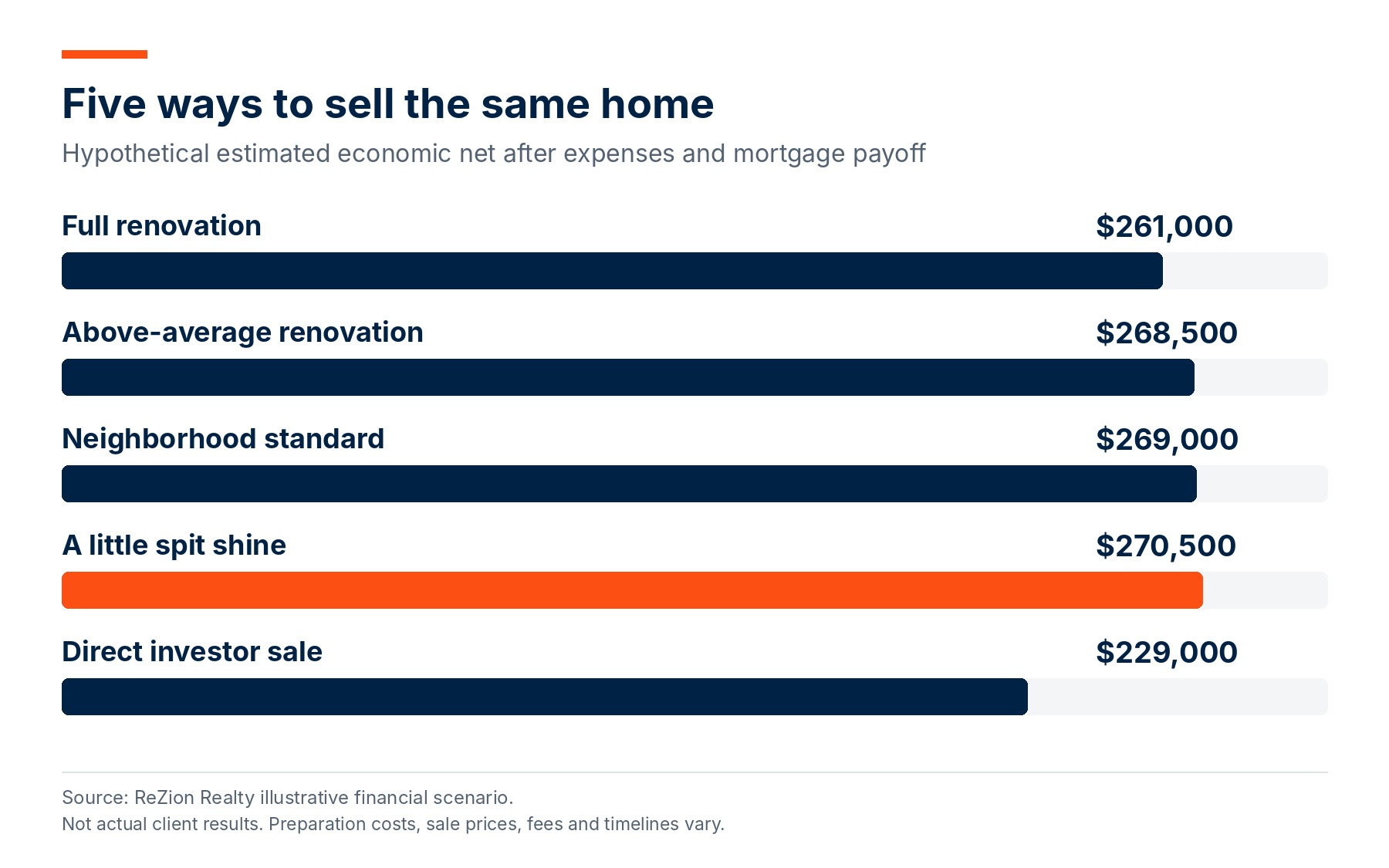
| Selling strategy | Estimated sale price | Preparation cost | Estimated economic net |
|---|---|---|---|
| Full renovation | $650,000 | $75,000 | $261,000 |
| Above-average renovation | $625,000 | $50,000 | $268,500 |
| Neighborhood-standard renovation | $600,000 | $30,000 | $269,000 |
| Targeted cosmetic improvements | $575,000 | $12,000 | $270,500 |
| Direct investor sale | $490,000 | $2,000 | $229,000 |
Illustrative assumptions: The first four strategies use selling expenses of 6% of the sale price. Carrying expenses are $18,000, $12,000, $9,000 and $6,000, respectively. Buyer concessions are $7,000, $7,000, $6,000 and $2,000. The direct investor scenario assumes $6,000 in selling expenses, $3,000 in carrying expenses and no buyer concessions. Each scenario assumes a $250,000 mortgage payoff. Additional renovation financing costs are excluded. Actual commissions and fees are negotiable.
What's interesting about this particular example is that we can completely renovate the property, spend $75,000 and sell the house for $650,000, or we can spend $12,000 shining the house up and sell it for $575,000. Even though the second house sells for $75,000 less, the homeowner actually walks away with $9,500 more in estimated economic net. That doesn't necessarily mean a cosmetic renovation is always the right answer. It means we need to evaluate the property and run the numbers before deciding how much money to put into it.
Now look at the investor option. In this scenario, the homeowner would walk away with $41,500 less than they potentially could by doing some targeted improvements and selling the house on the open market. For somebody who has the time and resources to get the property cleaned up, that may be a significant amount of money to leave on the table. But for somebody who has to relocate for a job, has inherited a property in another state or needs to get a parent into assisted living, that additional time and responsibility may not make sense for their situation.
That's why I don't automatically dismiss an investor sale, and I don't automatically recommend renovating every house. I want to understand what the homeowner needs, put the financial options in front of them, explain the risks associated with each option and let them make the decision that works best for their family. If we decide that doing some work to the property makes sense, I can help coordinate that work and manage the process.
You're driving the bus. I'm here to facilitate.
What should I do if my Denver home listing has already expired?
If your home listing has expired, avoid immediately repeating the same selling strategy without evaluating why the previous listing was unsuccessful. Review the original pricing, comparable sales, showing activity, buyer feedback, marketing and property condition. Then develop a new strategy that reflects current market conditions and your personal and financial circumstances.
The first thing I want to understand when I'm sitting down with somebody whose listing has expired is what's going on in their life. Why are they selling the house in the first place? Do they need to sell it, or would they simply like to sell it? Is there a financial situation we're trying to address, a relocation deadline we're working against or a family member who needs to move into a different living environment?
Those questions are important because the strategy I put together for somebody who has to relocate in 60 days may be completely different from the strategy I put together for somebody who has the flexibility to stay in their house for another year. Before we start making decisions about the real estate, I need to understand what we're actually trying to accomplish for the people involved.
Then I want to go back and look at what happened during the previous listing. How was the house originally priced? What kind of showing activity were we getting? Was there any consistent feedback from prospective buyers? Were we getting offers that didn't come together, or were we having difficulty getting people through the front door in the first place?
What can showing activity tell us?
| Previous listing activity | Possible issues to investigate |
|---|---|
| Very few showings | Pricing, online presentation, limited demand or showing restrictions |
| Numerous showings but no offers | Condition, perceived value, layout or competing properties |
| Consistently low offers | Differences between seller expectations and buyers' valuations |
| Offers that repeatedly fall apart | Inspection issues, financing, appraisal or transaction terms |
| Strong initial interest followed by inactivity | Changing market conditions or competition from newer listings |
None of these things automatically tells us what the problem is, but they give us a good place to start. From there, we can walk through the property, update the comparable sales, look at what we're competing against and determine whether there's anything we can do differently that would give us a better opportunity to get the house sold.
If that involves getting the contents out of the house, cleaning it up, painting, flooring, landscaping or doing a more substantial renovation, those are all things I can help coordinate. If the homeowner doesn't have the cash available to do the work, we can also evaluate whether there are appropriate financing options available and whether the additional costs and risks make financial sense. But I'm not interested in spending somebody's money just to make their house look better. There needs to be a financial reason for doing it.
Should I take my Denver home off the market and wait for prices to recover?
Waiting may make sense for homeowners who have flexibility, manageable housing expenses and no immediate need to sell. However, a future price recovery is not guaranteed, and the cost of holding a property can offset potential appreciation. Compare the financial consequences of selling today against realistic alternative scenarios before deciding to wait.
I get this question quite a bit, and the answer really depends on what's happening in your life. If you're comfortable in your home, you've got a low mortgage rate and there's no pressing reason to sell, staying where you are may be a perfectly reasonable decision. You don't necessarily need to sell your house just because the market has changed.
On the other hand, if you've already relocated, you're carrying two mortgages, you've inherited a vacant house or you need to tap into the equity of a property to pay for a parent's senior living expenses, waiting may have some fairly significant financial consequences. In those situations, we need to look at how much it's actually costing you to hold the property and how much the value would need to increase to make waiting financially worthwhile.
For example, if we're spending $3,000 a month in non-equity-building expenses to hold a property, that's $36,000 over the course of a year. The property would need to appreciate enough to offset those expenses, along with any additional selling costs, before waiting produces a better financial outcome. That's assuming the value actually goes up, which we certainly can't guarantee.
What happens if the market stays relatively flat over the next year, or if property values decline further? Can you comfortably absorb those expenses, and what does that do to the equity you're ultimately going to walk away with? Those are the different scenarios I want to evaluate with a homeowner rather than simply assuming the market is going to recover and everything will work itself out.
I'll be going into considerably more detail about this in Article #7 of this Denver Housing Market series, where we'll compare the financial implications of selling today with waiting for a potential market recovery.
How can I get my Denver home sold without leaving money on the table?
Getting a home sold in today's Denver market starts with understanding the property's current value, its competition and the homeowner's financial objectives. Comparing multiple selling strategies, estimated expenses, timelines and expected net proceeds allows homeowners to make informed decisions rather than automatically reducing their price or accepting a discounted investor offer.

If your house has been sitting on the market for several months, or your listing has already expired, I'd encourage you to evaluate your options before simply putting it back on the market. Sometimes the price is the problem, sometimes it's the condition of the property, sometimes it's the marketing strategy, and sometimes it's a combination of all three. What we need to figure out is what's going to make the biggest difference in your particular situation.
The way I approach these situations is to sit down with the homeowner, understand what's happening in their life, walk through the property and start putting together some different scenarios. We may determine that the house is priced appropriately and we need to do a better job marketing it. We may determine that there's some work we can do to the property that would potentially put more money in the homeowner's bank account. Or we may determine that selling it as-is is the best decision based on what they need to accomplish.
Every one of these situations is different, and I want the homeowner to understand what their options are, what those options are going to cost, how long each one may take and what they're realistically going to walk away with. Once we've figured that out, we can put together a plan, coordinate whatever needs to be done and work toward getting the property sold.
At the end of the day, selling the house is only part of what we're trying to accomplish. What I really want to do is maximize the situation for the homeowner and help them get to wherever they need to be next.
If you're in Broomfield, Arvada, Westminster, Thornton or anywhere in the Denver Metro area and you're struggling to get your home sold, give me a call. Let's take a look at the property, run the numbers and figure out what makes the most sense for you and your family.
Scott Jensen
ReZion Realty | Brokered by eXp Realty
Broomfield, Colorado | Serving Denver Metro
Phone: 720-352-7704
Email: scott@rezion.us
People first, contents second, real estate last.
Continue Reading the Denver Housing Market Series
I've put together this series to help Denver-area homeowners and prospective buyers better understand what's happening in our housing market and how those changes may affect their financial decisions.
- Article #3 — Why Are Denver Homes Harder to Afford Even When Prices Are Falling?
- Article #4 — Why Is My Denver Home Worth Less Than Its Appraised Value?
- Article #5 — Why Are So Many Denver Homes Expiring Without Selling? (You are here.)
- Coming next: Article #6 — Is Now a Good Time to Buy a House in Denver?
Research Sources
- Denver Metro Association of Realtors — November 2026 Market Trends Report
- Denver Metro Expired Listings Report — September 2026
- Denver Metro Housing Market — October 2026
- REcolorado MLS
- Freddie Mac Primary Mortgage Market Survey
Market information reflects reporting available as of November 24, 2026. Financial scenarios are illustrative and do not represent guaranteed sale prices, investment returns or actual client transactions. Individual property values, financing terms, expenses and selling timelines will vary. Homeowners should consult appropriate legal, tax and financial professionals regarding their individual circumstances.
Categories
Recent Posts